
Technical Support & Resources
Visit our FAQ
Contact Us
Toll Free Phone (USA and Canada Only): (888) 526-5351
Direct Phone: (734) 975-3888
Product Categories
Product Type
Application
Technical Information
- SARP-2
- Secreted Apoptosis-related Protein 2
- Secreted Frizzled-related Protein 1
Shipping & Storage Information
Recommended Products
Certificates of Analysis & Batch Specific Data
Provide batch numbers separated by commas to download or request available product inserts, QC sheets, certificates of analysis, data packs, and GC-MS data.

Explore Obesity & Metabolic Disease Resources
Discover high-quality research tools to investigate GLP-1 mechanisms and next-generation metabolic targets.
OBESITY RESEARCH SOLUTIONSProduct Description
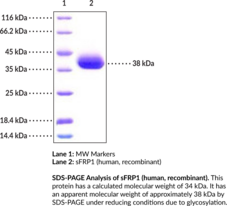
Secreted frizzled-related protein 1 (sFRP1) is a Wnt inhibitor and a member of the sFRP family.1,2 It is composed of a signal peptide, a cysteine-rich domain, and a netrin-like domain.1 sFRP1 is ubiquitously expressed, with the highest levels in the heart, ovary, testis, and small intestine.3 It inhibits Wnt signaling by sequestering Wnt directly via the cysteine-rich or netrin-like domains or competing with Wnt for binding to the cysteine-rich domain of Frizzled (Fz) receptors.1 sFRP1 is involved in apoptosis, adipocyte differentiation, angiogenesis, osteoblast proliferation and differentiation, development, and hematopoietic stem cell maintenance.1,2 Myocardial overexpression of Sfrp1 protects against decreases in cardiac function and increases in myocardium apoptosis in a mouse model of heart failure induced by transverse aortic constriction.4 Tumor protein levels of sFRP1 are decreased in early-stage breast cancer, which is associated with poor prognosis.5 Cayman’s sFRP1 (human, recombinant) protein can be used for cell-based assays. This protein consists of 294 amino acids, has a calculated molecular weight of 34 kDa, and a predicted N-terminus of Ser32 after signal peptide cleavage. By SDS-PAGE, under reducing conditions, the apparent molecular mass of the protein is 38 kDa due to glycosylation.
WARNING This product is not for human or veterinary use.
References & Product Citations
1. Secreted frizzled related proteins in cardiovascular and metabolic diseases. Front. Endocrinol. 12, 712217 (2021).
2. Wnt signaling and osteoblastogenesis. Rev. Endocr. Metab. Disord. 7(1-2), 33-39 (2006).
3. SARPs: A family of secreted apoptosis-
4. Sfrp1 attenuates TAC-
5. Loss of SFRP1 is associated with breast cancer progression and poor prognosis in early stage tumors. Int. J. Oncol. 25(3), 641-649 (2004).
Contact Info
Cayman Chemical1180 East Ellsworth RoadAnn Arbor, Michigan 48108 USAToll Free: (800) 364-9897(USA and Canada only)Fax: (734) 971-3640


