
Technical Support & Resources
Visit our FAQ
Contact Us
Toll Free Phone (USA and Canada Only): (888) 526-5351
Direct Phone: (734) 975-3888
Product Categories
Product Type
NKR-P1A/CD161 Extracellular Domain (mouse, recombinant)
Item No. 38063
Technical Information
- CD161 Antigen-like Family Member A
- Killer Cell Lectin-like Receptor Subfamily B Member 1A
- KLRB1A
- Natural Killer Cell Receptor P1A
Shipping & Storage Information
Recommended Products
Certificates of Analysis & Batch Specific Data
Provide batch numbers separated by commas to download or request available product inserts, QC sheets, certificates of analysis, data packs, and GC-MS data.
Kinase Resource Center
Discover Products & Resources for Kinase Research
- Kinase inhibitors, screening libraries, assay kits, & more
- Tools to study kinase signaling pathways:
- Growth factor signaling
- PI3K/Akt/mTOR
- MAPKs (ERK, p38, & JNK)
- JAK/STAT signaling
- Articles, resources, & advice
Product Description
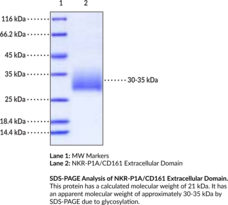
CD161, also known as natural killer (NK) cell receptor P1A (NKR-P1A), is a type II transmembrane protein that is encoded by the Klrb1a gene in mice.1 It is composed of an N-terminal cytoplasmic domain, a transmembrane domain, a stalk region, and an extracellular region that contains the C-type lectin-like domain and is expressed in NK cells and T cells.1,2 NKR-P1A is an inhibitory receptor in humans, which is stimulated by its ligand lectin-like transcript 1 (LLT-1) and signals through the PI3K/Akt/ERK pathway, whereas Nrk-p1a is an activating receptor in mice, which signals through the immunoreceptor tyrosine-based activation motifs (ITAMs) of adaptor proteins.1 Monoclonal antibodies targeting NKR-P1A increase T cell-induced cytotoxicity and decrease programmed cell death protein 1 (PD-1) levels in glioblastoma cells and knockout of KLRB1 increases survival in a humanized mouse model of glioblastoma.3 Levels of NKR-P1A are increased in CD4+ and CD8+ T cells in patients with advanced stage osteoarthritis.4 Cayman’s NKR-P1A/CD161 Extracellular Domain (mouse, recombinant) protein consists of 180 amino acids and has a calculated molecular weight of 21 kDa. By SDS-PAGE, under reducing conditions, the apparent molecular mass of the protein is 30-35 kDa due to glycosylation.
WARNING This product is not for human or veterinary use.
References & Product Citations
1. Nkrp1 family, from lectins to protein interacting molecules. Molecules 20(2), 3463-3478 (2015).
2. Murine natural killer cells and marrow graft rejection. Annu. Rev. Immunol. 10, 189-213 (1992).
3. Inhibitory CD161 receptor identified in glioma-
4. Chronic inflammation during osteoarthritis is associated with an increased expression of CD161 during advanced stage. Scand. J. Immunol. 90(1), e12770 (2019).
Contact Info
Cayman Chemical1180 East Ellsworth RoadAnn Arbor, Michigan 48108 USAToll Free: (800) 364-9897(USA and Canada only)Fax: (734) 971-3640


