
Technical Support & Resources
Visit our FAQ
Contact Us
Toll Free Phone (USA and Canada Only): (888) 526-5351
Direct Phone: (734) 975-3888
Product Categories
Product Type
Application
Technical Information
- NRP2a
- Vascular Endothelial Cell Growth Factor165 Receptor 2a
- VEGF165 Receptor 2a
Shipping & Storage Information
Recommended Products
Certificates of Analysis & Batch Specific Data
Provide batch numbers separated by commas to download or request available product inserts, QC sheets, certificates of analysis, data packs, and GC-MS data.
Kinase Resource Center
Discover Products & Resources for Kinase Research
- Kinase inhibitors, screening libraries, assay kits, & more
- Tools to study kinase signaling pathways:
- Growth factor signaling
- PI3K/Akt/mTOR
- MAPKs (ERK, p38, & JNK)
- JAK/STAT signaling
- Articles, resources, & advice
Product Description
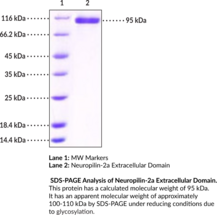
Neuropilin-2 (NRP-2) is a non-tyrosine kinase transmembrane glycoprotein co-receptor for class III semaphorins and VEGFs.1 It is composed of two CUB domains (a1 and a2), two Factor V/VIII homology domains (b1 and b2), a MAM domain, a transmembrane region, and a cytoplasmic tail. The a1, a2, and b1 domains are responsible for binding to class III semaphorins, including semaphorin-3C (Sema3C) and Sema3F, the b1 and b2 domains are responsible for binding to VEGFs, including VEGFA165, VEGFA145, VEGFC, VEGFD, and placenta growth factor (PlGF), and the MAM domain is important for homo- or heterodimerization.1,2 NRP-2 exists in three main isoforms: membrane-bound NRP-2a and NRP-2b, which are generated by alternative splicing and differ by the presence or absence, respectively, of the PDZ binding motif in the C-terminus, and soluble NRP-2 (sNRP-2), which is composed of the a1, a2, and b1 domains and a partial b2 domain.1 NRP-2a is expressed in the brain, heart, kidney, liver, lungs, placenta, trachea, and small intestine.3 NRP-2 is a co-receptor for VEGFR2 and VEGFR3 and is involved in angiogenesis, lymphangiogenesis, and neuronal guidance, as well as some immune functions such as T cell migration.2,4,1 Knockout of Nrp2a induces misprojections of axons originating from olfactory sensory neurons expressing transient receptor potential canonical 2 (TRPC2) in zebrafish.4 High tumoral expression of NRP2A is associated with poor overall survival in patients with muscle-invasive bladder cancer.5 Cayman’s Neuropilin-2a Extracellular Domain (human, recombinant) protein can be used for ELISA. This protein consists of 844 amino acids, has a calculated molecular weight of 95 kDa, and a predicted N-terminus of Gln23 after signal peptide cleavage. By SDS-PAGE, under reducing conditions, the apparent molecular mass of the protein is 100-110 kDa due to glycosylation.
WARNING This product is not for human or veterinary use.
References & Product Citations
1. Multifaceted role of neuropilins in the immune system: Potential targets for immunotherapy. Front. Immunol. 8, 1228 (2017).
2. Role of the VEGF/VEGFR axis in cancer biology and therapy. Advances in cancer research 114, 237-267 (2012).
3. Genomic organization of human neuropilin-
4. Loss of neuropilin2a/b or sema3fa alters olfactory sensory axon dynamics and protoglomerular targeting. Neural Dev. 17(1), 1 (2022).
5. Neuropilin-
Contact Info
Cayman Chemical1180 East Ellsworth RoadAnn Arbor, Michigan 48108 USAToll Free: (800) 364-9897(USA and Canada only)Fax: (734) 971-3640


