
Technical Support & Resources
Visit our FAQ
Contact Us
Toll Free Phone (USA and Canada Only): (888) 526-5351
Direct Phone: (734) 975-3888
Product Categories
Technical Information
- Tetrasialoganglioside GQ1b
Shipping & Storage Information
Recommended Products
Certificates of Analysis & Batch Specific Data
Provide batch numbers separated by commas to download or request available product inserts, QC sheets, certificates of analysis, data packs, and GC-MS data.
Lipid Resource Center
Discover Products & Resources for Lipid Research
- High-purity lipid standards
- Lipid roles in biology
- Lipids in health & disease
- Lipids for pharmaceutical development
- Protocols, advice, & resources
Product Description
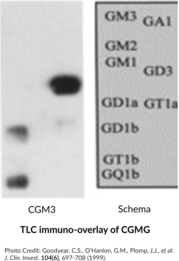
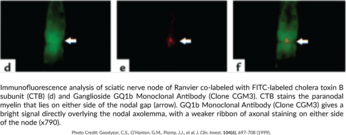
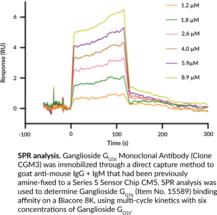
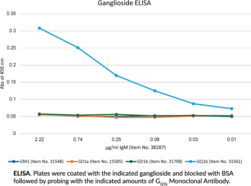
Ganglioside GQ1b is a sialic acid-containing glycosphingolipid that has been found in myelin of the oculomotor nerves and dorsal root ganglia, as well as neuromuscular spindle fibers.1,2 It is found on the plasma membrane, where it is anchored by the ceramide moiety with the sialylated oligosaccharide on the extracellular side.2 In axonal myelin, it helps to stabilize the paranodal region in the node of Ranvier.1 Ganglioside GQ1b is similar in shape to lipo-oligosaccharides (LOS) on the membrane of certain pathogens, including the bacterium C. jejuni. Due to this similarity, autoantibodies against ganglioside GQ1b can be formed during infection with C. jejuni. Ganglioside GQ1b monoclonal antibody (CGM3) induces muscle fiber twitching then paralysis in ex vivo mouse phrenic nerve hemidiaphragm preparations from mice passively immunized with ganglioside GQ1b monoclonal antibody (CGM3) but only when human serum is present to provide complement and not when applied alone.2 Autoantibodies against ganglioside GQ1b are found in the cerebrospinal fluid in a majority of patients during the acute phase of Miller-Fisher syndrome, a rare variant of Guillain-Barré syndrome characterized by eye movement abnormalities, impaired coordination, and tendon reflex loss.2,3,1 Cayman's Ganglioside GQ1b Monoclonal Antibody (Clone CGM3) binds to Ganglioside GQ1b Mixture (Item No. 15589) with ka, kd, and KD values of 9,200 M-1s-1, 0.0752 s-1, and 8.18 µM, respectively, as determined by surface plasmon resonance (SPR). It can be used for ELISA, immunofluorescence (IF), and TLC immunostaining applications.
WARNING This product is not for human or veterinary use.
References & Product Citations
1. Miller Fisher syndrome: An updated narrative review. Front. Neurol. 14, 1250774 (2023).
2. Monoclonal antibodies raised against Guillain-
3. Complement inhibition abrogates nerve terminal injury in Miller Fisher syndrome. Ann. Neurol. 58(2), 203-210 (2005).
Contact Info
Cayman Chemical1180 East Ellsworth RoadAnn Arbor, Michigan 48108 USAToll Free: (800) 364-9897(USA and Canada only)Fax: (734) 971-3640


