
Technical Support & Resources
Visit our FAQ
Contact Us
Toll Free Phone (USA and Canada Only): (888) 526-5351
Direct Phone: (734) 975-3888
Product Categories
Technical Information
- Antioxidant Protein 1
- AOP-1
- MER5 Homolog
- Mitochondrial Thioredoxin-dependent Peroxide Reductase
- Peroxiredoxin III
- PRDX3
- Prx3
Shipping & Storage Information
Recommended Products
Certificates of Analysis & Batch Specific Data
Provide batch numbers separated by commas to download or request available product inserts, QC sheets, certificates of analysis, data packs, and GC-MS data.

Explore Obesity & Metabolic Disease Resources
Discover high-quality research tools to investigate GLP-1 mechanisms and next-generation metabolic targets.
OBESITY RESEARCH SOLUTIONSProduct Description
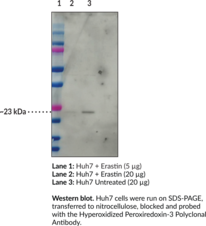
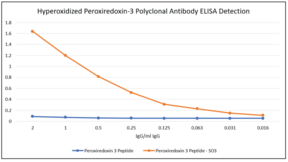
Peroxiredoxin-3 (Prx3) is a typical 2-Cys-containing Prx that is involved in the maintenance of cellular thiol redox homeostasis.1 It exists as a homodimer when oxidized and is composed of an N-terminal mitochondrial targeting sequence and a catalytic domain that contains peroxidatic and resolving cysteines (Cp and Cr, respectively).1,2 Reduced Prx3 exists as a monomer and hyperoxidized Prx3 is capable of forming dodecamers.2 Prx3 is ubiquitously expressed and localizes to the mitochondrial matrix.1,3 During the catalytic cycle, hydrogen peroxide oxidizes Cp to form a sulfenic acid intermediate (C-SOH), which reacts with the Cr of the opposite subunit to form a disulfide bond that is subsequently restored to a reduced state by thioredoxin 2 (Trx2).1,4 In the presence of high concentrations of hydrogen peroxide, Cp is oxidized to sulfinic acid (C-SO2H), which can be reduced by sulfiredoxin (Srx), or the irreversible sulfonic acid (C-SO3H) species.1 Knockout of the gene encoding thioredoxin reductase 2 (TrxR2) increases the levels of SO3-Prx3 in isolated mouse embryonic endothelial progenitor cells.4 Hyperoxidized Prx3 (SO2/3-Prx3) is also increased during ferroptosis induced by erastin or RSL3 in vitro.5 Liver levels of SO2/3-Prx3 are increased in mouse models of alcoholic fatty liver disease (AFLD) and non-alcoholic fatty liver disease (NAFLD). Cayman’s Hyperoxidized Peroxiredoxin-3 Polyclonal Antibody can be used for ELISA, immunofluorescence (IF), and Western blot (WB) applications. The antibody recognizes hyperoxidized Prx3 at approximately 23 kDa from human samples.
WARNING This product is not for human or veterinary use.
References & Product Citations
1. Interplay between mitochondrial peroxiredoxins and ROS in cancer development and progression. Int. J. Mol. Sci. 20(18), 4407 (2019).
2. Reconstitution of the mitochondrial PrxIII antioxidant defence pathway: General properties and factors affecting PrxIII activity and oligomeric state. J. Mol. Biol. 372(4), 1022-1033 (2007).
3. Human Protein Atlas of redox systems -
4. The mitochondrial thioredoxin reductase system (TrxR2) in vascular endothelium controls peroxynitrite levels and tissue integrity. Proc. Natl. Acad. Sci. USA 118(7), e1921828118 (2021).
5. Identification of hyperoxidized PRDX3 as a ferroptosis marker reveals ferroptotic damage in chronic liver diseases. Mol. Cell 83(21), P3931-3939.E3935 (2023).
An Arabidopsis protein-
Contact Info
Cayman Chemical1180 East Ellsworth RoadAnn Arbor, Michigan 48108 USAToll Free: (800) 364-9897(USA and Canada only)Fax: (734) 971-3640


