
Technical Support & Resources
Visit our FAQ
Contact Us
Toll Free Phone (USA and Canada Only): (888) 526-5351
Direct Phone: (734) 975-3888
Technical Information
- CD178
- CD95L
- FasL
- FASLG
- TNFL6
- TNF Ligand Superfamily Member 6
- TNFSF6
- Tumor Necrosis Factor Ligand 6
Shipping & Storage Information
Recommended Products
Certificates of Analysis & Batch Specific Data
Provide batch numbers separated by commas to download or request available product inserts, QC sheets, certificates of analysis, data packs, and GC-MS data.

Explore Obesity & Metabolic Disease Resources
Discover high-quality research tools to investigate GLP-1 mechanisms and next-generation metabolic targets.
OBESITY RESEARCH SOLUTIONSProduct Description
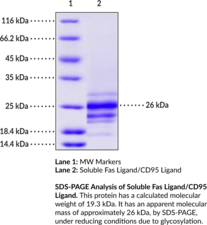
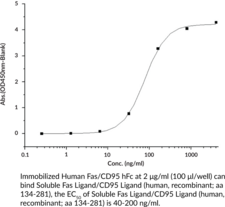
Fas ligand (FasL), also known as CD95L, is a type II transmembrane protein and member of the TNF superfamily.1 It is composed of a cytoplasmic domain, transmembrane domain, stalk region, TNF homology domain (THD), which is involved in homotrimerization, and Fas-binding domain. FasL is expressed in activated T cells, as well as the placenta, testis, lung, prostate, esophagus, uterus and spleen.2 Binding of FasL to its receptor Fas leads to formation of a death-inducing signaling complex (DISC) composed of CD95 oligomers, the Fas-associated death domain protein (FADD), and procaspase-8, procaspase-10, and cellular FLICE-like inhibitory protein (c-FLIP), which induces apoptosis.3 Soluble FasL (sFasL) is produced by proteolytic cleavage of FasL by various matrix metalloproteinases (MMPs) and either inhibits FasL-induced apoptosis or induces apoptosis in a context-dependent manner.1,4 sFasL induces migration of isolated human neutrophils and apoptosis in primary human distal lung epithelial cells.5,6 It decreases ankylosis in a rat model of collagen-induced arthritis.7 Serum levels of sFasL are increased in patients with insulin-dependent diabetes mellitus, systemic lupus erythematosus (SLE), rheumatoid arthritis, gastric cancer, or leukemia. Cayman’s Soluble Fas Ligand/CD95 Ligand (human, recombinant; aa 134-281) protein can be used for binding assays. This protein consists of 168 amino acids and has a calculated molecular weight of 19.3 kDa. By SDS-PAGE, under reducing conditions, the apparent molecular mass of the protein is 26 kDa due to glycosylation.
WARNING This product is not for human or veterinary use.
References & Product Citations
1. CD95 structure, aggregation and cell signaling. Front. Cell Dev. Biol. 8, 314 (2020).
2. Fas ligand is not only expressed in immune privileged human organs but is also coexpressed with Fas in various epithelial tissues. Mol. Pathol. 50(2), 87-91 (1997).
3. The role of CD95 and CD95 ligand in cancer. Cell Death Differ. 22(4), 549-559 (2015).
4. Membrane Fas ligand kills human peripheral blood T lymphocytes, and soluble Fas ligand blocks the killing. J. Exp. Med. 186(12), 2045-2050 (1997).
5. Soluble Fas ligand is chemotactic for human neutrophilic polymorphonuclear leukocytes. J. Immunol. 162(6), 3601–3606 (1999).
6. Soluble Fas ligand induces epithelial cell apoptosis in humans with acute lung injury (ARDS). J. Immunol. 163(4), 2217-2225 (1999).
7. Role of soluble Fas ligand in autoimmune diseases. World J. Gastroenterol. 10(21), 3151-3156 (2004).
Contact Info
Cayman Chemical1180 East Ellsworth RoadAnn Arbor, Michigan 48108 USAToll Free: (800) 364-9897(USA and Canada only)Fax: (734) 971-3640


