
Technical Support & Resources
Visit our FAQ
Contact Us
Toll Free Phone (USA and Canada Only): (888) 526-5351
Direct Phone: (734) 975-3888
Technical Information
- CD153
- CD30L
- TNFSF8
- Tumor Necrosis Factor Ligand Superfamily Member 8
Shipping & Storage Information
Recommended Products
Certificates of Analysis & Batch Specific Data
Provide batch numbers separated by commas to download or request available product inserts, QC sheets, certificates of analysis, data packs, and GC-MS data.
Kinase Resource Center
Discover Products & Resources for Kinase Research
- Kinase inhibitors, screening libraries, assay kits, & more
- Tools to study kinase signaling pathways:
- Growth factor signaling
- PI3K/Akt/mTOR
- MAPKs (ERK, p38, & JNK)
- JAK/STAT signaling
- Articles, resources, & advice
Product Description
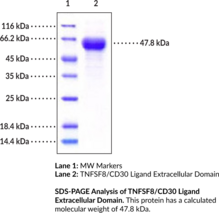
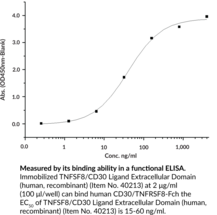
CD30 ligand (CD30L), also known as TNF superfamily member 8 (TNFSF8), is a single-pass type II membrane glycoprotein and member of the TNF and TNF receptor cytokine superfamily.1 It is composed of a cytoplasmic, transmembrane, and extracellular domain and forms non-covalent homotrimers.2,1 CD30L is expressed on activated T cells, as well as on B cells, macrophages, and granulocytes.1,3 It binds to CD30, inducing NF-κB- or ERK/MAPK-dependent downstream signaling that is involved in cell proliferation, cell activation, and the T cell-dependent immune response in a cell type- and cell activation status-dependent manner.1,3,4,5,6 CD30L can bind to both membrane-associated and soluble CD30, but binding to soluble CD30 prevents its binding to the membrane-bound form.1 CD30L is found on cells of various hematological cancers, including Hodgkin lymphoma and anaplastic large cell lymphoma, and expression of TNFSF8 is increased in leukocytes in autoimmune and inflammatory diseases, such as systemic lupus erythematosus (SLE) and asthma.4 Cayman’s TNFSF8/CD30 Ligand Extracellular Domain (human, recombinant; Fc-tagged) protein can be used for binding assays. This protein is a disulfide-linked homodimer. The reduced monomer, composed of CD30L (amino acids 63-234) fused to human IgG1 Fc at its N-terminus, consists of 429 amino acids, has a calculated molecular weight of 47.8 kDa, and a predicted N-terminus of Arg23 after signal peptide cleavage. As a result of glycosylation, the monomer migrates at approximately 60-65 kDa by SDS-PAGE under reducing conditions.
WARNING This product is not for human or veterinary use.
References & Product Citations
1. Soluble CD30 binds to CD153 with high affinity and blocks transmembrane signaling by CD30. Eur. J. Immunol. 32(1), 163-173 (2002).
2. CD30: Expression and function in health and disease. Semin. Immunol. 10(6), 457-470 (1998).
3. CD30/CD30 ligand (CD153) interaction regulates CD4+ T cell-
4. Targeting CD30/CD30L in oncology and autoimmune and inflammatory diseases. Adv. Exp. Med. Biol. 647, 174-185 (2009).
5. CD30: Receptor, marker, target. Pathol. Lab. Med. Int. 8(1), 27-36 (2016).
6. Understanding CD30 biology and therapeutic targeting: A historical perspective providing insight into future directions. Blood Cancer J. 7(9), e603 (2017).
Contact Info
Cayman Chemical1180 East Ellsworth RoadAnn Arbor, Michigan 48108 USAToll Free: (800) 364-9897(USA and Canada only)Fax: (734) 971-3640


