
Technical Support & Resources
Visit our FAQ
Contact Us
Toll Free Phone (USA and Canada Only): (888) 526-5351
Direct Phone: (734) 975-3888
GLP-1R (human, recombinant; aa 24-145) (Fc-tagged)
Item No. 40466
Technical Information
- GLP-1 Receptor
- GLP-1-R
- GLP1R
- Glucagon-like Peptide 1 Receptor
Shipping & Storage Information
Recommended Products
Certificates of Analysis & Batch Specific Data
Provide batch numbers separated by commas to download or request available product inserts, QC sheets, certificates of analysis, data packs, and GC-MS data.

Explore Obesity & Metabolic Disease Resources
Discover high-quality research tools to investigate GLP-1 mechanisms and next-generation metabolic targets.
OBESITY RESEARCH SOLUTIONSProduct Description
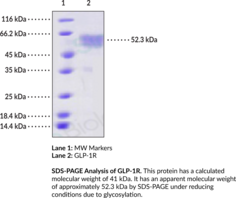
Glucagon-like peptide 1 receptor (GLP-1R) is a transmembrane G protein-coupled receptor (GPCR) and a member of the secretin family of receptors.1 It is composed of extracellular and transmembrane domains responsible for ligand binding and an intracellular domain responsible for signaling.1,2 It is primarily expressed in β-cells of the pancreas but also in adipocytes and pancreatic acinar cells, as well as the brain, kidney, stomach, and heart.3 When glucose levels are high, the incretin hormone GLP-1 binds to GLP-1R, which couples to Gαs and induces signaling through the cAMP/PKA pathway to stimulate insulin biosynthesis, potentiate insulin secretion, reduce glucagon secretion, and slow gastrointestinal mobility to increase satiety.1,3 GLP-1R can couple to either Gαs, Gαi/o, or Gαq and recruit β-arrestin to varying degrees in response to different agonists, a phenomenon known as biased agonism, with lower β-arrestin recruitment following activation by agonists with improved antidiabetic effects. Loss-of-function mutations in GLP1R are associated with reduced insulin secretion, which can be rescued in vitro with certain GLP-1R agonists and positive allosteric modulators (PAMs).4 GLP1R variants that impair cell surface expression of GLP-1R are associated with impaired glucose control, as well as increased adiposity, body mass index, and glycated hemoglobin A1c (Hb1Ac). Cayman’s GLP-1R (human, recombinant; aa 24-145) (Fc-tagged) protein is a disulfide-linked homodimer. The reduced monomer, composed of GLP-1R (24-145) fused to human IgG1 Fc at its C-terminus, consists of 360 amino acids, has a calculated molecular weight of 41 kDa, and a predicted N-terminus of Arg24 after signal peptide cleavage. As a result of glycosylation, the monomer migrates at approximately 52.3 kDa by SDS-PAGE under reducing conditions.
WARNING This product is not for human or veterinary use.
References & Product Citations
1. Biased agonism and polymorphic variation at the GLP-
2. Human GLP-
3. Glucagon-
4. Human GLP1R variants affecting GLP1R cell surface expression are associated with impaired glucose control and increased adiposity. Nat. Metab. 5(10), 1673-1684 (2023).
Contact Info
Cayman Chemical1180 East Ellsworth RoadAnn Arbor, Michigan 48108 USAToll Free: (800) 364-9897(USA and Canada only)Fax: (734) 971-3640


