
Technical Support & Resources
Visit our FAQ
Contact Us
Toll Free Phone (USA and Canada Only): (888) 526-5351
Direct Phone: (734) 975-3888
Product Categories
Product Type
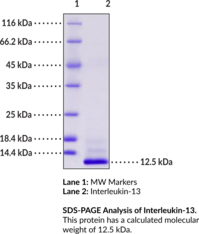
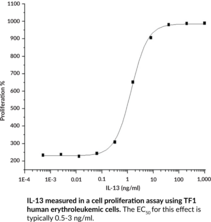
Technical Information
- ALRH Protein
- IL-13
Shipping & Storage Information
Recommended Products
Certificates of Analysis & Batch Specific Data
Provide batch numbers separated by commas to download or request available product inserts, QC sheets, certificates of analysis, data packs, and GC-MS data.
Kinase Resource Center
Discover Products & Resources for Kinase Research
- Kinase inhibitors, screening libraries, assay kits, & more
- Tools to study kinase signaling pathways:
- Growth factor signaling
- PI3K/Akt/mTOR
- MAPKs (ERK, p38, & JNK)
- JAK/STAT signaling
- Articles, resources, & advice
Product Description
Interleukin-13 (IL-13) is a cytokine that is involved in type 2 immunity.1,2,3 It is a secreted protein that is mainly expressed by activated T cells, but is also produced by mast cells, basophils, eosinophils, and nuocytes.4,3 Two amino acid sequences of IL-13 have been reported; one is 132 amino acids in length and the other with 14 additional amino acids at the N-terminus resulting in a 146 amino acid protein.4,5,6 IL-13 binds to a heterodimer of IL-4 receptor α (IL-4Rα) and IL-13Rα1 to initiate intracellular signaling through the JAK/STAT or PI3K pathways.3,7 It also binds to the decoy receptor, IL-13Rα2, to initiate TGF-β signaling.1,5,3 IL-13 has roles in host defense against helminth parasites, airway hyperresponsiveness, antitumor immunity, tissue remodeling, and mucus production.1,3 It induces the proliferation of activated B lymphocytes and the production of IgG and IgM by B cells co-cultured with T cells.4 Knockout of Il13 increases survival and decreases hepatic fibrosis in a mouse model of S. mansoni infection.8 SNPs in IL13 are associated with asthma.3 Protein levels of IL-13 are increased in primary and metastatic tumors compared with normal ovarian tissue in patients with ovarian cancer.9 Cayman’s Interleukin-13 (human, recombinant) protein is based on the 132 amino acid sequence and can be used for cell-based assay applications.
WARNING This product is not for human or veterinary use.
References & Product Citations
1. IL-
2. The differential expression of IL-
3. Interleukin-
4. Interleukin 13, a T-
5. Molecular basis for shared cytokine recognition revealed in the structure of an unusually high affinity complex between IL-
6. A molecular simulation analysis of vitamin D targets interleukin 13 (IL13) as an alternative to mometasone in asthma. 3 Biotech 8(8), 373 (2018).
7. Interleukins 4 and 13 increase intestinal epithelial permeability by a phosphatidylinositol 3-
8. Schistosome infection of transgenic mice defines distinct and contrasting pathogenic roles for IL-
9. Differential expression of interleukins IL-
Contact Info
Cayman Chemical1180 East Ellsworth RoadAnn Arbor, Michigan 48108 USAToll Free: (800) 364-9897(USA and Canada only)Fax: (734) 971-3640


