
Technical Support & Resources
Visit our FAQ
Contact Us
Toll Free Phone (USA and Canada Only): (888) 526-5351
Direct Phone: (734) 975-3888
Product Categories
Product Type
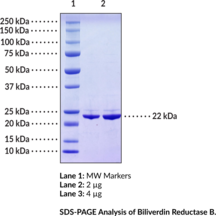
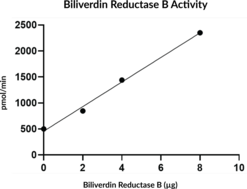
Technical Information
- Biliverdin-IX β-reductase
- BLVRB
- BVR-B
- FLR
- SCAN
- S-nitroso-CoA-assisted Nitrosyltransferase
Shipping & Storage Information
Recommended Products
Certificates of Analysis & Batch Specific Data
Provide batch numbers separated by commas to download or request available product inserts, QC sheets, certificates of analysis, data packs, and GC-MS data.

Explore Obesity & Metabolic Disease Resources
Discover high-quality research tools to investigate GLP-1 mechanisms and next-generation metabolic targets.
OBESITY RESEARCH SOLUTIONSProduct Description
Biliverdin reductase B, also known as S-nitroso-CoA-assisted nitrosyltransferase (SCAN), is an NADPH-dependent reductase and S-nitroso-CoA-dependent nitrosyltransferase encoded by BLVRB in humans that has roles in heme metabolism and insulin signaling.1,2 It is a monomeric enzyme composed of a dinucleotide-binding domain that binds both NADPH and a substrate.1 It is expressed in the liver and in erythrocytes and localizes to the cytoplasm.3,2 Biliverdin reductase B uses NADPH as an electron donor to reduce biliverdin-IXβ to bilirubin in the last step of heme degradation during fetal development.1,4 It can also reduce biliverdin-IXγ and biliverdin-IXδ, but not biliverdin-IXα, which is the predominant isoform in adults, as well as flavins, such as flavin mononucleotide (FMN), and ferric iron. Using S-nitroso-CoA (SNO-CoA) as a cofactor, biliverdin reductase B transfers SNO to cysteine residues in target proteins, such as the insulin receptor (InsR) and insulin receptor substrate 1 (IRS-1), which reduces insulin signaling.2 Human skeletal muscle, visceral adipose, and subcutaneous adipose levels of biliverdin reductase B are positively associated with increased SNO-InsRβ levels in these tissues and with body mass index (BMI). Intratumoral levels of biliverdin reductase B are increased in comparison with levels in non-cancerous tissue in patients with esophageal carcinoma, endometrial carcinoma, or pancreatic cancer, among other cancers.5 A serine-to-leucine substitution at residue 111 of biliverdin reductase B inhibits its activity for both biliverdins and flavins and is a risk factor for thrombocytosis in humans.6 Cayman’s Biliverdin Reductase B (human, recombinant) protein can be used for ELISA, enzyme activity assay, and Western blot applications.
WARNING This product is not for human or veterinary use.
References & Product Citations
1. In silico and crystallographic studies identify key structural features of biliverdin IXβ reductase inhibitors having nanomolar potency. The Journal of Biological Chemisty 293(15), 5431-5446 (2018).
2. An enzyme that selectively S-
3. Cloning and nucleotide sequence of a cDNA of the human erythrocyte NADPH-
4. Structure of human biliverdin IXβ reductase, an early fetal bilirubin IXβ producing enzyme. Nat. Struct. Biol. 8(3), 215-220 (2001).
5. Metabolic functions of biliverdin IXβ reductase in redox-
6. BLVRB redox mutation defines heme degradation in a metabolic pathway of enhanced thrombopoiesis in humans. Blood 128(5), 699-709 (2016).
Contact Info
Cayman Chemical1180 East Ellsworth RoadAnn Arbor, Michigan 48108 USAToll Free: (800) 364-9897(USA and Canada only)Fax: (734) 971-3640


