
Technical Support & Resources
Information provided in the product description is from published literature. Due to the nature of scientific experimentation, your results (e.g., selectivity and effective concentrations) or specific application for this product may differ. If you have questions about how this product fits your application, please contact our technical support staff.
Visit our FAQ
Contact Us
Toll Free Phone (USA and Canada Only): (888) 526-5351
Direct Phone: (734) 975-3888
Product Categories
Research Area
Application

Technical Information
- Coumarin 106
- MIC
- Mitophagy-inducing Coumarin
- NSC 290434
Shipping & Storage Information
Recommended Products
Certificates of Analysis & Batch Specific Data
Provide batch numbers separated by commas to download or request available product inserts, QC sheets, certificates of analysis, data packs, and GC-MS data.
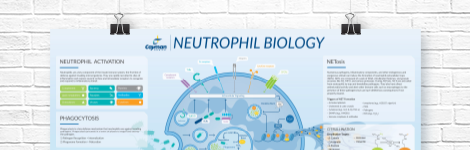
Neutrophil Biology Wall Poster
Explore how neutrophils shape the immune response in health and disease. This poster highlights neutrophil pathogen defense mechanisms, including phagocytosis, degranulation, and NETosis, as well as neutrophil roles in inflammation and NET-associated pathologies.
DOWNLOAD NOWProduct Description
Coumarin 478 is a synthetic coumarin and an antagonist of farnesoid X receptor (FXR) and DAF-12, the C. elegans functional ortholog.1 It inhibits agonist-induced activation of FXR or DAF-12 in reporter assays at 30 µM. Coumarin 478 inhibits mitochondrial reactive oxygen species (ROS) production induced by rotenone (Item No. 13995) and increases the oxygen consumption rate in C2C12 cells. It induces mitophagy in C. elegans neurons and body wall muscles and increases the lifespan of C. elegans. Coumarin 478 reduces amyloid-β (1-42)-induced paralysis and α-synuclein-induced thrashing in transgenic C. elegans expressing these human neurotoxic proteins in the muscles. It also inhibits acetylcholinesterase (AChE) and butyrylcholinesterase (BChE; IC50s = 10.7 and 27.8 µM, respectively) and is active against C. pneumoniae at 50 µM.2,3 Coumarin 478 displays absorption/emission maxima of 386/478 nm, respectively.4
WARNING This product is not for human or veterinary use.
References & Product Citations
1. Inhibition of acetylcholinesterase by coumarins: The case of coumarin 106. Pharmacol. Res. 58(3-4), 215-221 (2008).
2. Discovery of potent OTUB1/USP8 dual inhibitors targeting proteostasis in non-
3. Inhibitory effect of dietary phenolic compounds on Chlamydia pneumoniae in cell cultures. Biochem. Pharmacol. 71(6), 735-741 (2006).
4. New coumarin dyes with rigidized structure for flashlamp-
Contact Info
Cayman Chemical1180 East Ellsworth RoadAnn Arbor, Michigan 48108 USAToll Free: (800) 364-9897(USA and Canada only)Fax: (734) 971-3640


