
Technical Support & Resources
Visit our FAQ
Contact Us
Toll Free Phone (USA and Canada Only): (888) 526-5351
Direct Phone: (734) 975-3888
Product Categories
Technical Information
- Cell Division Protein Kinase 2
- Cyclin-dependent Kinase 2
- p33 Protein Kinase
Shipping & Storage Information
Recommended Products
Certificates of Analysis & Batch Specific Data
Provide batch numbers separated by commas to download or request available product inserts, QC sheets, certificates of analysis, data packs, and GC-MS data.
Kinase Resource Center
Discover Products & Resources for Kinase Research
- Kinase inhibitors, screening libraries, assay kits, & more
- Tools to study kinase signaling pathways:
- Growth factor signaling
- PI3K/Akt/mTOR
- MAPKs (ERK, p38, & JNK)
- JAK/STAT signaling
- Articles, resources, & advice
Product Description
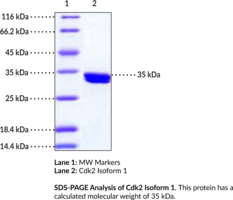
Cyclin-dependent kinase 2 (Cdk2) is a serine/threonine kinase and member of the CDK family of kinases involved in cell cycle regulation.1,2 It is composed of an N-terminal domain, an activation segment, also known as the T loop, and a catalytic C-terminal domain.2 Alternative splicing of CDK2 mRNA produces a full-length isoform or a shorter isoform that lacks exon 5, which encodes for part of the Cdk2 activation segment and contains residues that participate in interactions with cyclins.3 It is ubiquitously expressed and localizes to the cytoplasm or nucleus depending on the cell cycle stage.4,5 Cdk2 associates with cyclin E to mediate the G1/S transition and with cyclin A during S phase progression.1,2 Knockout of Cdk2 induces gametogenesis defects in mice but does not affect mitotic cell division.6 Protein levels of Cdk2 are increased in patients with oral squamous cell carcinoma, and overexpression of Cdk2/cyclin A or Cdk2/cyclin E is associated with poor prognosis in patients with oral cancer.7 Cayman’s Cdk2 Isoform 1 (human, recombinant) protein consists of 308 amino acids and has a calculated molecular weight of 35 kDa.
WARNING This product is not for human or veterinary use.
References & Product Citations
1. Cell cycle checkpoint genes and cancer. Encyclopedia of life sciences 1-6 (2005).
2. Insights on structural characteristics and ligand binding mechanisms of CDK2. Int. J. Mol. Sci. 16(5), 9314-9340 (2015).
3. PolyC-
4. Living with or without cyclins and cyclin-
5. Human cytomegalovirus infection results in altered Cdk2 subcellular localization. J. Gen. Virol. 78(Pt 8), 1993-1997 (1997).
6. Cyclin-
7. Overexpressio0n of CDK2 Is a prognostic indicator of oral cancer progression. Jpn. J. Cancer Res. 92(3), 352-360 (2001).
Contact Info
Cayman Chemical1180 East Ellsworth RoadAnn Arbor, Michigan 48108 USAToll Free: (800) 364-9897(USA and Canada only)Fax: (734) 971-3640


