
Features
- Screen test samples to quantify functional activity, either agonist or antagonist, that they may exert against human insulin receptor, isoform B (INSRb)
- Robust technology provides sustained response for consistent and reproducible data acquisition
- Included in kit: Ready-to-use, pre-transfected reporter cells | Optimized media | Reference agonist | Luciferase detection reagent | Cell culture ready assay plate
Technical Support & Resources
Visit our FAQ
Contact Us
Toll Free Phone (USA and Canada Only): (888) 526-5351
Direct Phone: (734) 975-3888
Product Categories
Product Type
Application
Technical Information
Shipping & Storage Information
Recommended Products
Certificates of Analysis & Batch Specific Data
Provide batch numbers separated by commas to download or request available product inserts, QC sheets, certificates of analysis, data packs, and GC-MS data.


Explore Obesity & Metabolic Disease Resources
Discover high-quality research tools to investigate GLP-1 mechanisms and next-generation metabolic targets.
OBESITY RESEARCH SOLUTIONSProduct Description
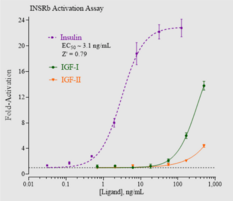
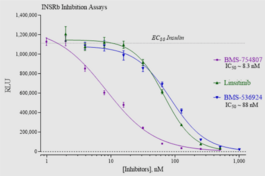
This is an all-inclusive cell-based luciferase reporter assay kit for the Human Insulin Receptor, isoform B (INSRb). INDIGO’s INSRb reporter assay utilizes proprietary mammalian cells that have been engineered to provide constitutive expression of INSRb. In addition to INSRb Reporter Cells, this kit provides two optimized media for use during cell culture and in diluting the user’s test samples, a reference activator, Luciferase Detection Reagent, and a cell culture-ready assay plate. The principal application of this assay is in the screening of test samples to quantify any functional activity, either activating or inhibitory, that they may exert against human INSRb or the coupled RAS-MAPK pathway.
Insulin Receptor is a glycosylated, disulfide-linked α2β2 tetramer that belongs to a subfamily of receptor tyrosine kinases, including insulin-like growth factor 1 receptor (IGF-1R) and insulin-receptor-related receptor (IRR). Two isoforms of the insulin receptor are known, the full-length INSRb and the smaller INSRa, which is the product of splice variation that excludes exon 112. Reporter cells expressing the larger INSRb are provided in this assay kit. The two insulin receptor isoforms derive from respective precursor proteins which have been processed by a furin-like protease to produce an α/β subunit complex. The α/β subunits then undergo disulfide linkage to form a mature, functional tetrameric receptor. Insulin receptors exist as both homodimers and heterodimers of each isoform. In addition, receptor hybrids of INSRb and IGF-1R have been characterized. Insulin is a 5.73 kD non-glycosylated globular protein that is the predominant physiological ligand of the insulin receptors3. It is produced by beta cells of the pancreatic islets, and it is considered one of the main anabolic hormones of the body. Insulin binds to and activates the insulin receptor, promoting the absorption of glucose from the blood into the liver, fat, and skeletal muscle cells. Type 1 diabetes (T1D) can arise when pancreatic cells lose the ability to produce insulin. The consequence is a damaging build-up of sugars in the bloodstream. Activation of the insulin receptor also controls transcription of metabolic genes that contribute to cellular growth and differentiation. However, dysregulation of insulin-mediated signaling is linked to many human diseases, such as type 2 diabetes (T2D) and cancers. Consequently, the insulin receptor and its associated receptors command considerable interest in therapeutics development and drug safety screening.
INDIGO’s INSRb Reporter Cells express a hybrid Elk-1 transprion factor in which the native Elk-1 DNA-binding domain (DBD) has been replaced with the yeast Gal4 DBD sequence. The luciferase reporter gene is functionally linked to an upstream Gal4 Upstream Activation Sequence (UAS). When activated, Elk-1 binds to the UAS elements to initiate the formation of a complete transcription complex that drives Luciferase gene expression. Quantifying changes in luciferase activity in the treated reporter cells relative to the untreated cells provides a sensitive, dose-dependent surrogate measure of drug-induced changes in INSRb activity.
Therefore, the principal application of this assay is in the screening of test materials to quantify any functional interactions, either activating or inhibitory, that they may exert against INSRb or the coupled RAS-MAPK pathway.
WARNING This product is not for human or veterinary use.
Contact Info
Cayman Chemical1180 East Ellsworth RoadAnn Arbor, Michigan 48108 USAToll Free: (800) 364-9897(USA and Canada only)Fax: (734) 971-3640


