
Technical Support & Resources
Visit our FAQ
Contact Us
Toll Free Phone (USA and Canada Only): (888) 526-5351
Direct Phone: (734) 975-3888
Technical Information
- IL-1 Receptor-associated Kinase 4
- Interleukin-1 Receptor-associated Kinase 4
- Renal Carcinoma Antigen NY-REN-64
Shipping & Storage Information
Recommended Products
Certificates of Analysis & Batch Specific Data
Provide batch numbers separated by commas to download or request available product inserts, QC sheets, certificates of analysis, data packs, and GC-MS data.
Kinase Resource Center
Discover Products & Resources for Kinase Research
- Kinase inhibitors, screening libraries, assay kits, & more
- Tools to study kinase signaling pathways:
- Growth factor signaling
- PI3K/Akt/mTOR
- MAPKs (ERK, p38, & JNK)
- JAK/STAT signaling
- Articles, resources, & advice
Product Description
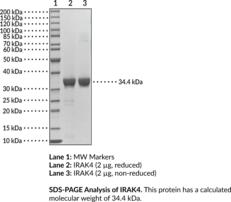
IL-1 receptor-associated kinase 4 (IRAK4) is a serine/threonine kinase involved in Toll/IL-1 receptor (TIR) signaling.1,2 It is composed of an N-terminal death domain, which is involved in dimerization and interaction with MyD88, a proline/serine/threonine-rich domain, and a C-terminal kinase domain.2 IRAK4 is ubiquitously expressed and localizes to the cytoplasm.1,3 It has roles in innate and adaptive immunity, interacts with IRAK1, MyD88, and TNF receptor-associated factor 6 (TRAF6), and signals through the NF-κB and MAPK pathways.2,1 Homozygous knockout of Irak4 increases susceptibility to M. bovis infection in mice and decreases survival and increases lung bacterial burden in a mouse model of M. tuberculosis infection, however, Irak4-/- mice are resistant to LPS-induced septic shock.4,5 Mutations in IRAK4 are associated with an increased risk of invasive bacterial infections in children.6 Cayman’s IRAK4 (human, recombinant) protein can be used for enzyme activity assays. This protein has a calculated molecular weight of 34.4 kDa.
WARNING This product is not for human or veterinary use.
References & Product Citations
1. IRAK-
2. IRAK family in inflammatory autoimmune diseases. Autoimmun. Rev. 19(3), 102461 (2020).
3. Natural loss-
4. Lack of IL-
5. Severe impairment of interleukin-
6. Selective predisposition to bacterial infections in IRAK-
Contact Info
Cayman Chemical1180 East Ellsworth RoadAnn Arbor, Michigan 48108 USAToll Free: (800) 364-9897(USA and Canada only)Fax: (734) 971-3640


