
Technical Support & Resources
Visit our FAQ
Contact Us
Toll Free Phone (USA and Canada Only): (888) 526-5351
Direct Phone: (734) 975-3888
Product Categories
Product Type

Technical Information
- Gastric Inhibitory Polypeptide Receptor
- Glucose-dependent Insulinotropic Polypeptide Receptor
Shipping & Storage Information
Recommended Products
Certificates of Analysis & Batch Specific Data
Provide batch numbers separated by commas to download or request available product inserts, QC sheets, certificates of analysis, data packs, and GC-MS data.

Explore Obesity & Metabolic Disease Resources
Discover high-quality research tools to investigate GLP-1 mechanisms and next-generation metabolic targets.
OBESITY RESEARCH SOLUTIONSProduct Description
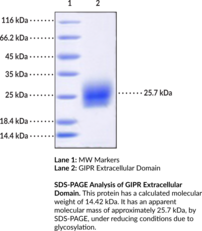
Glucose-dependent insulinotropic polypeptide receptor (GIPR) is a transmembrane glycoprotein hormone receptor and class B1 G protein-coupled receptor (GPCR).1 It is composed of an N-terminal extracellular domain required for ligand binding, seven transmembrane domains, and a C-terminal intracellular domain. GIPR is expressed in adipose tissue and the pancreas, gut, heart, pituitary gland, adrenal cortex, and brain and localizes to the plasma membrane.2,3 It is involved in insulin and glucagon secretion, bone remodeling, and lipid metabolism, is activated by the endogenous ligands GIP (1-42) and GIP (1-30) amide, and induces primarily Gαs signaling.4,2,5 Knockout of GIPR increases lipolysis in white adipose tissue and reduces body weight gain and fat mass in a mouse model of obesity induced by a high-fat diet.4 SNPs in GIPR are associated with type 2 diabetes.6 Cayman’s GIPR Extracellular Domain (human, recombinant; aa 26-138) protein can be used for binding assays. This protein consists of 124 amino acids, has a calculated molecular weight of 14.42 kDa, and a predicted N-terminus of Gly26 after signal peptide cleavage. By SDS-PAGE, under reducing conditions, the apparent molecular mass of the protein is 25.7 kDa due to glycosylation.
WARNING This product is not for human or veterinary use.
References & Product Citations
1. Insights into the structure and activation mechanism of some class B1 GPCR family members. Mol. Biol. Rep. 51(1), 966 (2024).
2. The evolving story of incretins (GIP and GLP-
3. Regulation of GIP and GLP1 receptor cell surface expression by N-
4. GIP receptor deletion in mice confers resistance to high-
5. GIP-
6. Association of incretin receptors genetic polymorphisms with type 2 diabetes mellitus in Egyptian patients. J. Gene Med. 19(9-10), e2973 (2017).
Contact Info
Cayman Chemical1180 East Ellsworth RoadAnn Arbor, Michigan 48108 USAToll Free: (800) 364-9897(USA and Canada only)Fax: (734) 971-3640


