
Features
- Screen test samples to quantify functional activity, either agonist or antagonist, that they may exert against human fibroblast growth factor receptor 4
- Robust technology provides sustained response for consistent and reproducible data acquisition
- iii. Included in kit: Ready-to-use, pre-transfected reporter cells | Optimized media | Reference agonist | Luciferase detection reagent | Cell culture ready assay plate
Technical Support & Resources
Visit our FAQ
Contact Us
Toll Free Phone (USA and Canada Only): (888) 526-5351
Direct Phone: (734) 975-3888
Product Categories
Product Type
Application
Technical Information
Shipping & Storage Information
Recommended Products
Certificates of Analysis & Batch Specific Data
Provide batch numbers separated by commas to download or request available product inserts, QC sheets, certificates of analysis, data packs, and GC-MS data.

Kinase Resource Center
Discover Products & Resources for Kinase Research
- Kinase inhibitors, screening libraries, assay kits, & more
- Tools to study kinase signaling pathways:
- Growth factor signaling
- PI3K/Akt/mTOR
- MAPKs (ERK, p38, & JNK)
- JAK/STAT signaling
- Articles, resources, & advice
Product Description
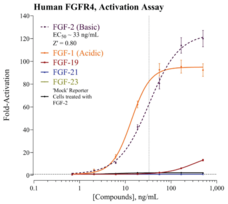
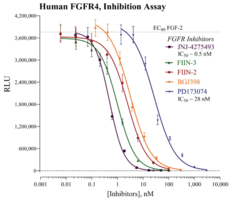
This is an all-inclusive cell-based luciferase reporter assay kit targeting the Human Fibroblast Growth Factor Receptor 4 (FGFR4). INDIGO’s FGFR4 reporter assay utilizes proprietary mammalian cells that have been engineered to provide constitutive expression of the Human Fibroblast Growth Factor Receptor 4. In addition to FGFR4 Reporter Cells, this kit provides two optimized media for use during cell culture and in diluting the user’s test samples, a reference agonist, Luciferase Detection Reagent, and a cell culture-ready assay plate. The principal application of this assay is in the screening of test samples to quantify any functional activity, either agonist or antagonist, that they may exert against human FGFR4. This kit provides researchers with clear, reproducible results, exceptional cell viability post-thaw, and consistent results lot to lot. Kits must be stored at -80C. Do not store in liquid nitrogen. Note: reporter cells cannot be refrozen or maintained in extended culture.
The family of Fibroblast Growth Factors (FGFs) comprise approximately 23 members that are related by core sequence and structure conservation, with the majority of FGFs being secreted signaling proteins. Secreted FGFs are predominantly autocrine and paracrine factors, with only three members evolved to function as endocrine factors.
FGFs bind and activate four FGF Receptors (FGFR1-4) which, themselves, are members of the family of high-affinity tyrosine kinase receptors. Heparin and heparin sulfate proteoglycans (HSPGs) are essential cofactors for paracrine FGF (e.g., FGF-1 and FGF-2) interactions with FGFRs. The association between paracrine FGFs and HSPGs ensures their limited diffusion and enhanced FGFR binding specificity.
In contrast to the paracrine ligand activators of FGFR, endocrine FGFs (e.g., FGF-19, FGF-21, and FGF-23) have minimal affinity to heparin. Rather, they typically require association with members of the Klotho family of proteins as cofactors for efficient binding to their cognate receptor(s). Although, FGF-23 activation of FGFR3 can occur in a Klotho independent manner, signaling through the PLCγ/calcineurin/NFAT pathway.
The FGFs are broad-spectrum mitogens that, through their receptor interactions, regulate a variety of cellular functions including migration, proliferation, differentiation, metabolism and survival. In particular, FGF/FGFR signaling plays a critical role in regulating metabolism in the kidney, liver, brain, intestine and adipose tissues. Not surprisingly, dysfunctional FGFR signaling can lead to a range of physiological disorders. For example, mutation, amplification, and gene fusion may result in abnormal morphogenesis and the progression of several types of cancer. Consequently, the FGF receptors continue to command much interest as targets for drug development and drug safety screening. [INDIGO Catalog Nos. IB43001, IB43002]
WARNING This product is not for human or veterinary use.
Contact Info
Cayman Chemical1180 East Ellsworth RoadAnn Arbor, Michigan 48108 USAToll Free: (800) 364-9897(USA and Canada only)Fax: (734) 971-3640


