
Technical Support & Resources
Visit our FAQ
Contact Us
Toll Free Phone (USA and Canada Only): (888) 526-5351
Direct Phone: (734) 975-3888
Product Categories
Technical Information
- PDH Kinase 1
- Pyruvate Dehydrogenase (acetyl-transferring) Kinase Isozyme 1
- Pyruvate Dehydrogenase Kinase Isoform 1
Shipping & Storage Information
Recommended Products
Certificates of Analysis & Batch Specific Data
Provide batch numbers separated by commas to download or request available product inserts, QC sheets, certificates of analysis, data packs, and GC-MS data.
Kinase Resource Center
Discover Products & Resources for Kinase Research
- Kinase inhibitors, screening libraries, assay kits, & more
- Tools to study kinase signaling pathways:
- Growth factor signaling
- PI3K/Akt/mTOR
- MAPKs (ERK, p38, & JNK)
- JAK/STAT signaling
- Articles, resources, & advice
Product Description
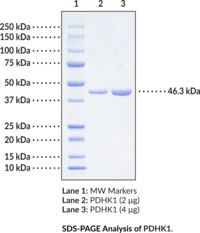
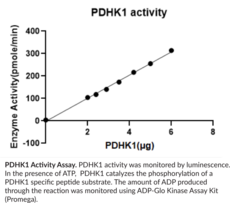
Pyruvate dehydrogenase kinase 1 (PDHK1) is a kinase and regulator of glycolysis and oxidative phosphorylation.1,2,3 It is expressed primarily in the heart and to a lesser extent in skeletal muscle, liver, brain, placenta, lung, pancreas, and kidney and is localized to the mitochondria.1 PDHK1 phosphorylates three serine residues on the E1 subunit of the pyruvate dehydrogenase complex, inhibiting the oxidative decarboxylation of pyruvate to acetyl-CoA and instead promoting its conversion to lactate.2,3 Pharmacologic inhibition of PDHK1 inhibits both proliferation and survival of T helper 17 (Th17) cells and suppresses Th17-mediated inflammation in rodent models of inflammatory bowel disease (IBD) and experimental autoimmune encephalomyelitis (EAE).2 Levels of PDHK1 are increased in and associated with malignancy in lung cancers and pancreatic ductal adenocarcinomas, and pharmacologic inhibition of PDHK1 reverses the Warburg phenotype in various tumor models in vitro and in vivo.4,3 Cayman’s PDHK1 (human, recombinant) protein can be used for activity assay, binding study, and Western blot (WB) applications.
WARNING This product is not for human or veterinary use.
References & Product Citations
1. Diversity of the pyruvate dehydrogenase kinase gene family in humans. The Journal of Biological Chemisty 270(48), 28989-28994 (1995).
2. Metabolic programming and PDHK1 control CD4+ T cell subsets and inflammation. J. Clin. Invest. 125(1), 194-207 (2015).
3. Discovery of ATP competitive PDHK1/2 dual inhibitors. Bioorg. Med. Chem. Lett. 122, 130190 (2025).
4. Novel dichloroacetophenone-
Contact Info
Cayman Chemical1180 East Ellsworth RoadAnn Arbor, Michigan 48108 USAToll Free: (800) 364-9897(USA and Canada only)Fax: (734) 971-3640


