
Technical Support & Resources
Visit our FAQ
Contact Us
Toll Free Phone (USA and Canada Only): (888) 526-5351
Direct Phone: (734) 975-3888
Product Categories

Technical Information
- KW 4354
- NSC 309710
- R 35443
Shipping & Storage Information
Recommended Products
Certificates of Analysis & Batch Specific Data
Provide batch numbers separated by commas to download or request available product inserts, QC sheets, certificates of analysis, data packs, and GC-MS data.
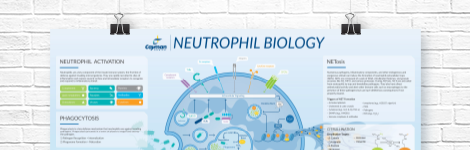
Neutrophil Biology Wall Poster
Explore how neutrophils shape the immune response in health and disease. This poster highlights neutrophil pathogen defense mechanisms, including phagocytosis, degranulation, and NETosis, as well as neutrophil roles in inflammation and NET-associated pathologies.
DOWNLOAD NOWProduct Description
Oxatomide is a histamine H1 receptor antagonist (Ki = 15 nM).1 It is selective for the histamine H1 receptor over muscarinic acetylcholine receptors (mAChRs; Ki = 263 nM) but also inhibits the serotonin (5-HT) receptor subtype 5-HT2 (Ki = 7 nM). Oxatomide inhibits histamine release induced by an anti-IgE antibody in isolated human lung fragments (IC50 = 4.5 nM) and degranulation of RBL-2H3 mast cells induced by A23187 (Item No. 22030).2,3 It also inhibits nitric oxide (NO) production induced by LPS in RAW 264.7 cells when used at a concentration of 50 µM, and superoxide production induced by N-formyl-Met-Leu-Phe (fMLP; Item No. 21495) or phorbol 12-myristate 13-acetate (PMA; Item No. 10008014) in isolated rat neutrophils in a concentration-dependent manner.4,5 Oxatomide reduces histamine-induced vascular permeability in mice (ED50 = 2.9 mg/kg).1 Formulations containing oxatomide have been used in the treatment of allergic symptoms.
WARNING This product is not for human or veterinary use.
References & Product Citations
1. Studies on the novel antiallergic agent HSR-
2. Inhibition of histamine release from human lung in vitro by antihistamines and related drugs. Br. J. Pharmacol. 69(4), 663-667 (2019).
3. Antiallergic activity of 3-
4. The effects of H1-
5. Inhibitory effect of epinastine on superoxide generation by rat neutrophils. Jpn. J. Pharmacol. 68, 449-452 (1995).
Contact Info
Cayman Chemical1180 East Ellsworth RoadAnn Arbor, Michigan 48108 USAToll Free: (800) 364-9897(USA and Canada only)Fax: (734) 971-3640


