
Features
- Screen test samples to quantify functional activity, either agonist or antagonist, that they may exert against human fibroblast growth factor receptor 1c and α-Klotho (FGFR/α-Klotho)
- Robust technology provides sustained response for consistent and reproducible data acquisition
- Included in kit: Ready-to-use, pre-transfected reporter cells | Optimized media | Reference agonist | Luciferase detection reagent | Cell culture ready assay plate
Technical Support & Resources
Visit our FAQ
Contact Us
Toll Free Phone (USA and Canada Only): (888) 526-5351
Direct Phone: (734) 975-3888
Product Categories
Product Type
Research Area
Application
Technical Information
Shipping & Storage Information
Recommended Products
Certificates of Analysis & Batch Specific Data
Provide batch numbers separated by commas to download or request available product inserts, QC sheets, certificates of analysis, data packs, and GC-MS data.

Kinase Resource Center
Discover Products & Resources for Kinase Research
- Kinase inhibitors, screening libraries, assay kits, & more
- Tools to study kinase signaling pathways:
- Growth factor signaling
- PI3K/Akt/mTOR
- MAPKs (ERK, p38, & JNK)
- JAK/STAT signaling
- Articles, resources, & advice
Product Description
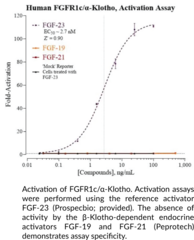
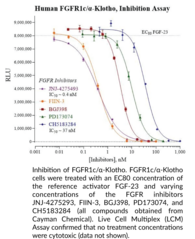
This is an all-inclusive cell-based luciferase reporter assay kit targeting the Human Fibroblast Growth Factor Receptor 1c and α-Klotho (FGFR/α-Klotho). INDIGO’s FGFR/α-Klotho reporter assay utilizes proprietary mammalian cells that have been engineered to provide constitutive expression of the Human Fibroblast Growth Factor Receptor 1c and α-Klotho. In addition to FGFR/α-Klotho Reporter Cells, this kit provides two optimized media for use during cell culture and in diluting the user’s test samples, a reference agonist, Luciferase Detection Reagent, and a cell culture-ready assay plate. The principal application of this assay is in the screening of test samples to quantify any functional activity, either agonist or antagonist, that they may exert against human FGFR/α-Klotho. This kit provides researchers with clear, reproducible results, exceptional cell viability post-thaw, and consistent results lot to lot. Kits must be stored at -80C. Do not store in liquid nitrogen. Note: reporter cells cannot be refrozen or maintained in extended culture.
The family of Fibroblast Growth Factors (FGFs) comprise approximately 23 members that are related by core sequence and structure conservation, with the majority of FGFs being secreted signaling proteins. Secreted FGFs are predominantly autocrine and paracrine factors, with only three members evolved to function as endocrine factors. Paracrine FGFs show high affinity towards the extracellular matrix (ECM) component heparin sulfate (HS) and are thus retained in the ECM and function locally. In contrast, the atypical endocrine subfamily of FGFs, that comprise FGF-19, FGF-21, and FGF-23, have reduced affinity for HS and can therefore escape from the ECM into the circulation to distant reach target distant organs.
FGFs bind and activate FGF Receptors (FGFRs) which, themselves, are members of the family of high-affinity tyrosine kinase receptors. The endocrine FGF-23 activates the receptor complex FGFR1c and its co-receptor α-Klotho (FGFR1c/α-Klotho). FGF-23 is a principal regulator in the maintenance of serum phosphorus concentration by inhibiting renal tubular phosphate reabsorption. Unfortunately, various FGF-23-mediated disorders exist. The most common of these is X-linked hypophosphoatemia (XLH). Additional disorders of FGF-23 signaling include autosomal dominant and recessive hypophosphophatemic rickets, fibrous dysplasia, and tumor-induced osteomalacia. Consequently, FGF-23 and FGFR1c/α-Klotho command considerable interest as therapeutic targets in drug development and drug safety screening. [INDIGO Catalog Nos. IB40001, IB40002]
WARNING This product is not for human or veterinary use.
Contact Info
Cayman Chemical1180 East Ellsworth RoadAnn Arbor, Michigan 48108 USAToll Free: (800) 364-9897(USA and Canada only)Fax: (734) 971-3640


