
Technical Support & Resources
Visit our FAQ
Contact Us
Toll Free Phone (USA and Canada Only): (888) 526-5351
Direct Phone: (734) 975-3888
Product Categories
Product Type
Application
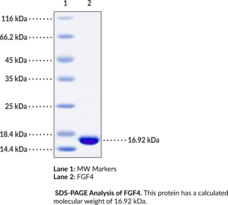
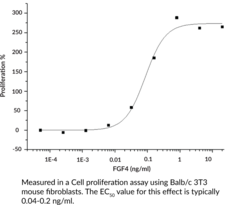
Technical Information
- Fibroblast Growth Factor 4
- HBGF-4
- Heparin-binding Growth Factor 4
- Heparin Secretory-Transforming Protein 1
- HST-1
- HSTF-1
- K-FGF
- Transforming Protein KS3
Shipping & Storage Information
Recommended Products
Certificates of Analysis & Batch Specific Data
Provide batch numbers separated by commas to download or request available product inserts, QC sheets, certificates of analysis, data packs, and GC-MS data.
Kinase Resource Center
Discover Products & Resources for Kinase Research
- Kinase inhibitors, screening libraries, assay kits, & more
- Tools to study kinase signaling pathways:
- Growth factor signaling
- PI3K/Akt/mTOR
- MAPKs (ERK, p38, & JNK)
- JAK/STAT signaling
- Articles, resources, & advice
Product Description
Fibroblast growth factor 4 (FGF4) is a secreted protein and member of the FGF4 subfamily and is involved in development.1 It is composed of an N-terminal signaling peptide, heparin-binding sites, and a receptor-binding domain.1,2 FGF4 is expressed in both epithelial and mesenchymal cells and, once secreted, binds to Ig-like domain IIIc on FGFR1, FGFR2, and FGFR3.3 FGF4 is required for embryonic development and is involved in limb and cardiac valve development, as well as the proliferation and differentiation of stem cells and many other processes.4,1,5 Cayman’s FGF4 (human, recombinant) protein can be used for cell-based assays. The protein was synthesized from a DNA sequence encoding the mature form of FGF4 (Ser54-Leu206) with an N-terminal translation-initiating methionine (Met1). The expressed protein consists of 154 amino acids, has a calculated molecular weight of 16.92 kDa, and a predicted N-terminus of Met1.
WARNING This product is not for human or veterinary use.
References & Product Citations
1. The Fibroblast Growth Factor signaling pathway. Wiley Interdiscip. Rev. Dev. Biol. 4(3), 215-266 (2015).
2. Identification of receptor and heparin binding sites in fibroblast growth factor 4 by structure-
3. Receptor specificity of the fibroblast growth factor family. The Journal of Biological Chemisty 271(25), 15292-15297 (1996).
4. Pleiotropic function of FGF-
5. Fibroblast growth factor (FGF)-
Contact Info
Cayman Chemical1180 East Ellsworth RoadAnn Arbor, Michigan 48108 USAToll Free: (800) 364-9897(USA and Canada only)Fax: (734) 971-3640


