
Technical Support & Resources
Visit our FAQ
Contact Us
Toll Free Phone (USA and Canada Only): (888) 526-5351
Direct Phone: (734) 975-3888
Technical Information
- Transforming Growth Factor β3
Shipping & Storage Information
Recommended Products
Certificates of Analysis & Batch Specific Data
Provide batch numbers separated by commas to download or request available product inserts, QC sheets, certificates of analysis, data packs, and GC-MS data.
Kinase Resource Center
Discover Products & Resources for Kinase Research
- Kinase inhibitors, screening libraries, assay kits, & more
- Tools to study kinase signaling pathways:
- Growth factor signaling
- PI3K/Akt/mTOR
- MAPKs (ERK, p38, & JNK)
- JAK/STAT signaling
- Articles, resources, & advice
Product Description
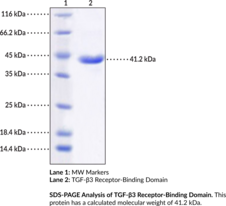
TGF-β3 is a multifunctional cytokine and member of the TGF-β superfamily.1 TGF-β3 is expressed as a proprotein that is cleaved in the Golgi to form TGF-β3 latency-associated peptide (LAP) and mature TGF-β3.2 TGF-β3 and TGF-β3 LAP remain non-covalently bound until mature TGF-β3 is released from latency by various proteins, including matrix metalloproteinases and plasmin.2,1 Secreted TGF-β3 homodimers induce signaling through activin receptor-like kinase 5 (ALK5), also known as TGF-β receptor type 1 (TGF-βRI), and TGF-β receptor type 2 (TGFBR2) and is involved in embryonic development, epidermal homeostasis, wound healing, bone formation, and involution of excess mammary gland epithelial cells during lactation.1 It increases collagen levels in primary human foreskin fibroblasts.3 High levels of TGF-β3 are associated with disease progression in patients with osteosarcoma.4 Cayman's TGF-β3 Receptor-Binding Domain (human, recombinant) protein is a disulfide-linked homodimer. The reduced monomer, composed of TGF-β3 (amino acids 301-412) fused to human IgG1 Fc at its N-terminus, consists of 373 amino acids and has a calculated molecular weight of 41.2 kDa.
WARNING This product is not for human or veterinary use.
References & Product Citations
1. TGF-
2. TGF-
3. TGF-
4. Expression of transforming growth factor-
Contact Info
Cayman Chemical1180 East Ellsworth RoadAnn Arbor, Michigan 48108 USAToll Free: (800) 364-9897(USA and Canada only)Fax: (734) 971-3640


