
Technical Support & Resources
Visit our FAQ
Contact Us
Toll Free Phone (USA and Canada Only): (888) 526-5351
Direct Phone: (734) 975-3888
Technical Information
- FGF-9
- Fibroblast Growth Factor 9
- GAF
- Glia-activating Factor
- HBGF-9
- Heparin-binding Growth Factor 9
Shipping & Storage Information
Recommended Products
Certificates of Analysis & Batch Specific Data
Provide batch numbers separated by commas to download or request available product inserts, QC sheets, certificates of analysis, data packs, and GC-MS data.
Kinase Resource Center
Discover Products & Resources for Kinase Research
- Kinase inhibitors, screening libraries, assay kits, & more
- Tools to study kinase signaling pathways:
- Growth factor signaling
- PI3K/Akt/mTOR
- MAPKs (ERK, p38, & JNK)
- JAK/STAT signaling
- Articles, resources, & advice
Product Description
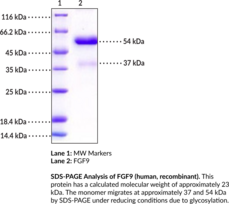
FGF9 is a signaling polypeptide and the prototypical member of the FGF9 subfamily.1 It is composed of N- and C-terminal domains and a central β-trefoil core. It lacks a classical signaling sequence but is trafficked through the endoplasmic reticulum and Golgi to be secreted. FGF9 is widely expressed in epithelial and mesenchymal cells during embryonic development and in the CNS, kidneys, adrenal gland, and a variety of other organs in adults.2,1 After secretion, it binds to FGFR1c, FGFR2c, and FGFR3c on mesenchymal cells in conjunction with its co-receptor, heparan sulfate proteoglycan (HSPG), also known as CD44, to induce MAPK, PI3K, and PLCγ signaling.1 It also binds to epithelium-expressed FGFR3b with HSPG to induce PI3K signaling. FGF9 is highly involved in embryonic development of the lungs, heart, gonads, skeletal system, and gastrointestinal system.1,3 Mice lacking Fgf9 display respiratory failure, heart deformations, and partial or full male-to-female sex reversal.4,5 A serine-to-asparagine substitution at position 99 (FGF9S99N) is associated with multiple synostoses syndrome 3 (SYNS3), which is characterized by multiple bone fusions and joint semi-dislocations.6,1 Cayman’s FGF9 (human, recombinant) protein can be used for cell-based assays. This protein is a disulfide-linked homodimer. The reduced monomer, composed of FGF9 (amino acids 20-208) fused to human IgG1 Fc at its N-terminus, consists of 463 amino acids, has a calculated molecular weight of approximately 23 kDa, and a predicted N-terminus of Glu20 after signal peptide cleavage. As a result of glycosylation, the monomer migrates at approximately 37 and 54 kDa by SDS-PAGE under reducing conditions.
WARNING This product is not for human or veterinary use.
References & Product Citations
1. .
2. .
3. .
4. .
5. .
6. .
Contact Info
Cayman Chemical1180 East Ellsworth RoadAnn Arbor, Michigan 48108 USAToll Free: (800) 364-9897(USA and Canada only)Fax: (734) 971-3640


