
Technical Support & Resources
Visit our FAQ
Contact Us
Toll Free Phone (USA and Canada Only): (888) 526-5351
Direct Phone: (734) 975-3888
Product Categories
Technical Information
- Fibrinogen-like Protein 1
- Hepassocin
- Hepatocyte-derived Fibrinogen-related Protein 1
- HFREP-1
- HP-041
- HPS
- Liver Fibrinogen-related Protein
- LFIRE-1
Shipping & Storage Information
Recommended Products
Certificates of Analysis & Batch Specific Data
Provide batch numbers separated by commas to download or request available product inserts, QC sheets, certificates of analysis, data packs, and GC-MS data.

Explore Obesity & Metabolic Disease Resources
Discover high-quality research tools to investigate GLP-1 mechanisms and next-generation metabolic targets.
OBESITY RESEARCH SOLUTIONSProduct Description
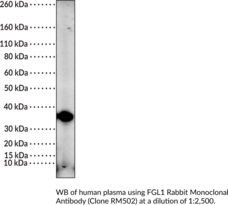
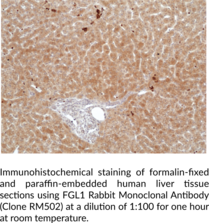
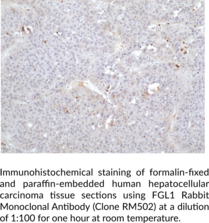
Fibrinogen-like protein 1 (FGL1) is a member of the fibrinogen protein family.1,2 It functions as a homodimer and is composed of an N-terminal coiled-coiled domain, which promotes homo-oligomerization or hetero-oligomerization with lymphocyte activation gene 3 (LAG-3), and a C-terminal fibrinogen-like domain but lacks a platelet-binding region found in other fibrinogen proteins.1 FGL1 is expressed in and secreted from the liver and to a lesser extent in brown adipose tissue.1,3 It decreases anti-Cd3-induced proliferation in wild-type mouse T cells but not in Lag3-/- mouse T cells.2 Fgl1 knockout increases body weight, the liver weight to body weight ratio, hepatic triglyceride levels, and plasma cholesterol, free fatty acid, and glucose levels in mice.3 Plasma FGL1 levels are increased in patients with hyperglycemia.4 Cayman's FGL1 Rabbit Monoclonal Antibody (Clone RM502) can be used for immunohistochemistry (IHC) and Western blot (WB) applications.
WARNING This product is not for human or veterinary use.
References & Product Citations
1. Molecular cloning and initial characterization of a novel fibrinogen-
2. Fibrinogen-
3. Targeted deletion of fibrinogen like protein 1 reveals a novel role in energy substrate utilization. PLos One 8(3), e58084 (2013).
4. The hepatic protection effects of hepassocin in hyperglycemic crisis. J. Clin. Endocrinol. Metab. 102(7), 2407-2415 (2017).
Contact Info
Cayman Chemical1180 East Ellsworth RoadAnn Arbor, Michigan 48108 USAToll Free: (800) 364-9897(USA and Canada only)Fax: (734) 971-3640


