
Technical Support & Resources
Visit our FAQ
Contact Us
Toll Free Phone (USA and Canada Only): (888) 526-5351
Direct Phone: (734) 975-3888
Product Categories
Application
5-Hydroxymethylcytosine DNA Matched Antibody Pair (Clones RM236/RM476)
Item No. 42874
Technical Information
- 5-hmC
Shipping & Storage Information
Recommended Products
Certificates of Analysis & Batch Specific Data
Provide batch numbers separated by commas to download or request available product inserts, QC sheets, certificates of analysis, data packs, and GC-MS data.

Visit Our Cancer Resource Center
Find Tools & Resources to Study the Hallmarks of Cancer
- Cancer cell signaling & regulation
- Cancer metabolism
- Tumor microenvironment
Product Description
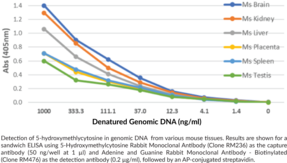
5-Hydroxymethylcytosine (5-hmC) is an epigenetic modification formed from the oxidation of 5-methylcytosine (5-mC) by Tet dioxygenases.1 5-hmC is primarily a stable DNA modification, but it can be oxidized by Tet enzymes and its products further modified to generate nonmethylated cytosine, indicating a role as an intermediate in DNA demethylation as well.2,3,4 It is associated with actively transcribed genes and recognized by a variety of proteins, including proteins involved in DNA repair and DNA metabolic processes.2,4 5-hmC has been found in all mammalian tissues but levels are higher in the brain relative to other tissues.5 The percentage of genomic 5-hmC in mouse cerebellum increases during postnatal development until adulthood, and genes acquiring intragenic 5-hmC are enriched in pathways associated with age-related neurodegenerative disease pathways in adult mice.6 In contrast, 5-hmC levels are reduced by up to 8-fold in cancer tissues.2,7 Cayman’s 5-Hydroxymethylcytosine DNA Matched Antibody Pair (Clones RM236/RM476) contains 5-Hydroxymethylcytosine Rabbit Monoclonal Antibody (Clone RM236) (Item No. 20723) as a capture antibody and Adenine-Guanine Rabbit Monoclonal Antibody - Biotinylated (Clone RM476) as a detection antibody. This antibody pair can be used for sandwich ELISAs or other sandwich assays for the specific detection of 5-hmC in ssDNA.
WARNING This product is not for human or veterinary use.
References & Product Citations
1. Conversion of 5-
2. 5-
3. Epigenetic regulatory functions of DNA modifications: 5-
4. Dynamic readers for 5-
5. Tissue distribution of 5-
6. Selective chemical labeling reveals the genome-
7. Epigenomic analysis of 5-
Contact Info
Cayman Chemical1180 East Ellsworth RoadAnn Arbor, Michigan 48108 USAToll Free: (800) 364-9897(USA and Canada only)Fax: (734) 971-3640


