
Technical Support & Resources
Visit our FAQ
Contact Us
Toll Free Phone (USA and Canada Only): (888) 526-5351
Direct Phone: (734) 975-3888
Product Categories
Product Type
Application
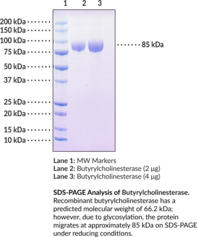
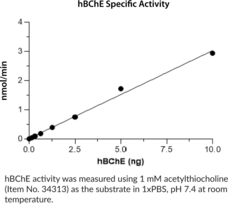
Technical Information
- Acylcholine Acylhydrolase
- BChE
- BuChE
- Butyrylcholine Esterase
- CHE1
- Choline Esterase II
- Cholinesterase
- Plasma Cholinesterase
- Pseudocholinesterase
Shipping & Storage Information
Recommended Products
Certificates of Analysis & Batch Specific Data
Provide batch numbers separated by commas to download or request available product inserts, QC sheets, certificates of analysis, data packs, and GC-MS data.
Product Description
Butyrylcholinesterase (BChE) is a serine hydrolase that preferentially hydrolyzes butyrylcholine (BCh) but can also hydrolyze acetylcholine (ACh).1 It is composed of a large catalytic domain and C-terminal tetramerization domain.2 BChE can exist as a monomer but primarily oligomerizes into soluble or membrane-anchored tetramers by combining with polyproline-rich peptides, such as lamellipodin.3,2 It is widely expressed with high levels in the plasma, liver, lungs, and brain.4,1 In addition to its hydrolysis of BCh and ACh, BChE also hydrolyzes certain ester-containing exogenous substances.5 Due to this, loss-of-function mutations in BCHE are associated with the accumulation of exogenous BChE substrates, including the muscle relaxant succinylcholine (Item No. 32829), which can lead to adverse effects such as prolonged apnea.5,6 BChE is implicated in the regulation of the peptide hormone ghrelin, and dysregulation of BChE is found in various conditions, including Alzheimer’s disease, where it is found in amyloid-β plaques and neurofibrillary tangles, and sudden infant death syndrome (SIDS), where it is found at reduced levels in infant dried blood spots.7,1,8 Cayman’s Butyrylcholinesterase (human, recombinant) protein can be used for enzyme activity assays.
WARNING This product is not for human or veterinary use.
References & Product Citations
1. Butyrylcholinesterase: A multifaceted pharmacological target and tool. Curr. Protein Pept. Sci. 21(1), 99-109 (2020).
2. The C5 variant of the butyrylcholinesterase tetramer includes a noncovalently bound 60 kda lamellipodin fragment. Molecules 22(7), 1083 (2017).
3. Crystal structure of human butyrylcholinesterase and of its complexes with substrate and products. The Journal of Biological Chemisty 278(42), 41141-41147 (2023).
4. Acetylcholinesterase and butyrylcholinesterase--
5. Butyrylcholinesterase (BCHE) genotyping for post-
6. Butyrylcholinesterase deficiency and its clinical importance in anaesthesia: A systematic review. Anaesthesia 74(4), 518-528 (2019).
7. Quantification of butyrylcholinesterase activity as a sensitive and specific biomarker of alzheimer’s disease. J. Alzheim. Assoc. 58(2), 491-505 (2017).
8. Butyrylcholinesterase is a potential biomarker for sudden infant death syndrome. EBioMedicine 80, 104041 (2022).
Contact Info
Cayman Chemical1180 East Ellsworth RoadAnn Arbor, Michigan 48108 USAToll Free: (800) 364-9897(USA and Canada only)Fax: (734) 971-3640


