
Technical Support & Resources
Visit our FAQ
Contact Us
Toll Free Phone (USA and Canada Only): (888) 526-5351
Direct Phone: (734) 975-3888
Product Categories
Product Type
Application
Technical Information
- Astrocyte-derived Trophic Factor
- ATF
- Glial Cell Line-derived Neurotrophic Factor
Shipping & Storage Information
Recommended Products
Certificates of Analysis & Batch Specific Data
Provide batch numbers separated by commas to download or request available product inserts, QC sheets, certificates of analysis, data packs, and GC-MS data.
Kinase Resource Center
Discover Products & Resources for Kinase Research
- Kinase inhibitors, screening libraries, assay kits, & more
- Tools to study kinase signaling pathways:
- Growth factor signaling
- PI3K/Akt/mTOR
- MAPKs (ERK, p38, & JNK)
- JAK/STAT signaling
- Articles, resources, & advice
Product Description
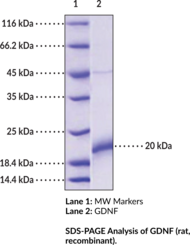
Glial cell line-derived neurotrophic factor (GDNF) is a neurotrophic factor and member of the TGF-β superfamily.1 It is produced as a preproprotein with the signal peptide cleaved upon secretion and the protein activated after further cleavage. It is expressed in the CNS, with high levels in the caudate nucleus of the striatum, and in the PNS, including in the mesenchyme, kidney, and gastrointestinal tract.2,3 GDNF forms homodimers and binds to its coreceptor, GDNF family receptor α1 (GFRα1), and, together, they bind the tyrosine kinase RET in a cis or trans configuration and activate ERK1/2 or PI3K/Akt signaling pathways, respectively.4,1 Through these pathways, GDNF mediates cell survival and cytokine expression to promote neuronal survival and neuroprotection.5 GDNF is involved in dopaminergic neuron development and differentiation, enteric neuron precursor migration, kidney development, and spermatogonia differentiation.5,1 Exogenous GDNF reduces alcohol drinking in rhesus monkeys trained to chronically drink alcohol, and serum levels of GDNF are reduced in patients dependent on alcohol.6,7 Mutations in GDNF, alone or in combination with other gene mutations, are a cause of Hirschsprung disease, a neural crest disease characterized by distal colonic aganglionosis.8 Cayman's GDNF (rat, recombinant) protein can be used for cell-based assays. This protein consists of 150 amino acids and has a calculated molecular weight of 17.1 kDa. By SDS-PAGE, under reducing conditions, the apparent molecular mass of the protein is 20 kDa.
WARNING This product is not for human or veterinary use.
References & Product Citations
1. The GDNF family: Signalling, biological functions and therapeutic value. Nat. Rev. Neurosci. 3(5), 383-394 (2002).
2. Multiple astrocyte transcripts encode nigral trophic factors in rat and human. Exp. Neurol. 130(2), 387-393 (1994).
3. Cellular expression of GDNF mRNA suggests multiple functions inside and outside the nervous system. Cell Tissue Res. 286(2), 191-207 (1996).
4. Architecture and regulation of a GDNF-
5. Molecular mechanisms of GDNF/GFRA1/RET and PI3K/AKT/ERK signaling interplay in neuroprotection: Therapeutic strategies for treating neurological disorders. Neuropeptides 111, 102516 (2025).
6. GDNF gene therapy for alcohol use disorder in male non-
7. BDNF and GDNF serum levels in alcohol-
8. The science of Hirschsprung disease: What we know and where we are headed. Semin. Pediatr. Surg. 31(2), 151157 (2022).
Contact Info
Cayman Chemical1180 East Ellsworth RoadAnn Arbor, Michigan 48108 USAToll Free: (800) 364-9897(USA and Canada only)Fax: (734) 971-3640


