
Technical Support & Resources
Visit our FAQ
Contact Us
Toll Free Phone (USA and Canada Only): (888) 526-5351
Direct Phone: (734) 975-3888
Product Categories
Technical Information
- c-Jun N-terminal Kinase 1
- JNK-46
- MAPK8
- MAP Kinase 8
- Mitogen-activated Protein Kinase 8
- SAPK1C
- Stress-activated Protein Kinase 1C
Shipping & Storage Information
Recommended Products
Certificates of Analysis & Batch Specific Data
Provide batch numbers separated by commas to download or request available product inserts, QC sheets, certificates of analysis, data packs, and GC-MS data.
Kinase Resource Center
Discover Products & Resources for Kinase Research
- Kinase inhibitors, screening libraries, assay kits, & more
- Tools to study kinase signaling pathways:
- Growth factor signaling
- PI3K/Akt/mTOR
- MAPKs (ERK, p38, & JNK)
- JAK/STAT signaling
- Articles, resources, & advice
Product Description
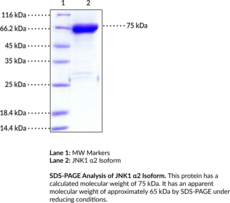
JNK1 is a stress-activated serine/threonine protein kinase and member of the MAPK family.1 It is composed of a short N-terminal helical domain, a flexible connector that contains the active site, and a large helical C-terminal domain.2 JNK1 is encoded by MAPK8, which produces four isoforms via alternative splicing.3 JNK1 is ubiquitously expressed and is found in the cytoplasm.1,3,4 JNKs are activated by phosphorylation at threonine 183 (Thr183) and tyrosine 185 (Tyr185) by MAP kinase kinase 7 (MKK7) and MKK4, respectively, in response to stress stimuli, such as cellular stress, radiation, inflammation, or oxidative stress.5,1 After activation, JNKs localize to the nucleus where they phosphorylate transcription factors, nuclear receptors, and adaptor proteins that broadly regulate cell proliferation, cell survival, and apoptosis.4 Increased intratumoral levels of JNK1 are associated with decreased survival in patients with hepatocellular carcinoma (HCC).6 Cayman's JNK1 α2 Isoform (human, recombinant) protein consists of 652 amino acids and has a calculated molecular weight of 75 kDa. This protein migrates at approximately 65 kDa by SDS-PAGE under reducing conditions.
WARNING This product is not for human or veterinary use.
References & Product Citations
1. JNK pathway signaling: A novel and smarter therapeutic target for various biological diseases. Future Med. Chem. 7(15), 2065-2086 (2015).
2. Structural basis for the selective inhibition of JNK1 by the scaffolding protein JIP1 and SP600125. EMBO J. 23(11), 2185-2195 (2004).
3. Discovery of potent and selective covalent inhibitors of JNK. Chem. Biol. 19(1), 140-154 (2012).
4. Uses for JNK: The many and varied substrates of the c-
5. Activation by phosphorylation and purification of human c-
6. JNK1 activation predicts the prognostic outcome of the human hepatocellular carcinoma. Mol. Cancer 8, 64 (2009).
Contact Info
Cayman Chemical1180 East Ellsworth RoadAnn Arbor, Michigan 48108 USAToll Free: (800) 364-9897(USA and Canada only)Fax: (734) 971-3640


