
Technical Support & Resources
Visit our FAQ
Contact Us
Toll Free Phone (USA and Canada Only): (888) 526-5351
Direct Phone: (734) 975-3888
Product Categories
Technical Information
- Cell Cycle Checkpoint Kinase 1
- Checkpoint Kinase 1
- CHK1 Checkpoint Homolog
- Serine/threonine-protein Kinase Chk1
Shipping & Storage Information
Recommended Products
Certificates of Analysis & Batch Specific Data
Provide batch numbers separated by commas to download or request available product inserts, QC sheets, certificates of analysis, data packs, and GC-MS data.
Kinase Resource Center
Discover Products & Resources for Kinase Research
- Kinase inhibitors, screening libraries, assay kits, & more
- Tools to study kinase signaling pathways:
- Growth factor signaling
- PI3K/Akt/mTOR
- MAPKs (ERK, p38, & JNK)
- JAK/STAT signaling
- Articles, resources, & advice
Product Description
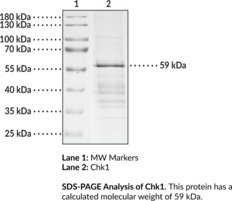
Checkpoint kinase 1 (Chk1) is a serine/threonine kinase and downstream effector of ataxia-telangiectasia and RAD3-related protein/kinase (ATR) in the cellular DNA damage response.1,2 It is composed of an N-terminal kinase domain, a flexible linker region, a serine/glutamine cluster, and a C-terminal regulatory domain, which contains two conserved motifs, CM1 and CM2, that mediate kinase autoinhibition.2,3 Chk1 is ubiquitously expressed and localized primarily to the nucleus.3,4 In response to single-stranded DNA (ssDNA) generated from replication stress, DNA crosslinking, or other damage, ATR phosphorylates Chk1 at serine 345 and 317 inducing its activation and cell cycle arrest at the S or G2/M phase.4 Loss of one copy of Chek1 induces erythropoietic defects, anemia, and sudden death in mice, while Chek1 knockout is embryonically lethal. Pharmacologic inhibition of Chk1 increases DNA damage and enhances antitumor efficacy of chemotherapeutic agents in various mouse xenograft models.5 Cayman’s Chk1 (human, recombinant) protein can be used for enzyme activity assay and Western blot (WB) applications. This protein has a calculated molecular weight of 59 kDa.
WARNING This product is not for human or veterinary use.
References & Product Citations
1. ATR/CHK1 inhibitors and cancer therapy. Radiother. Oncol. 126(3), 450-464 (2018).
2. Roles of Chk1 in cell biology and cancer therapy. Int. J. Cancer 134(5), 1013-1023 (2014).
3. Structural basis for recruitment of the CHK1 DNA damage kinase by the CLASPIN scaffold protein. Structure 29(6), 531-539 (2021).
4. Reality CHEK: Understanding the biology and clinical potential of CHK1. Cancer Lett. 497, 202-211 (2021).
5. LY2603618, a selective CHK1 inhibitor, enhances the anti-
Contact Info
Cayman Chemical1180 East Ellsworth RoadAnn Arbor, Michigan 48108 USAToll Free: (800) 364-9897(USA and Canada only)Fax: (734) 971-3640


