
Technical Support & Resources
Visit our FAQ
Contact Us
Toll Free Phone (USA and Canada Only): (888) 526-5351
Direct Phone: (734) 975-3888
Product Categories
Technical Information
- Protein Kinase Lysine-deficient 4
- Protein Kinase With No Lysine 4
- Serine/threonine Protein Kinase WNK4
- With No Lysine Kinase 4
- WNK Lysine Deficient Protein Kinase 4
Shipping & Storage Information
Recommended Products
Certificates of Analysis & Batch Specific Data
Provide batch numbers separated by commas to download or request available product inserts, QC sheets, certificates of analysis, data packs, and GC-MS data.
Kinase Resource Center
Discover Products & Resources for Kinase Research
- Kinase inhibitors, screening libraries, assay kits, & more
- Tools to study kinase signaling pathways:
- Growth factor signaling
- PI3K/Akt/mTOR
- MAPKs (ERK, p38, & JNK)
- JAK/STAT signaling
- Articles, resources, & advice
Product Description
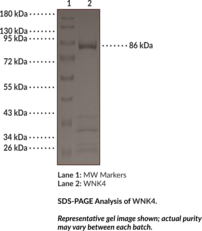
WNK lysine deficient protein kinase 4 (WNK4) is a kinase member of the serine/threonine protein kinase family.1,2 It is composed of an N-terminal kinase domain, a PF2-like autoinhibitory domain, a coiled-coiled domain, an acidic motif, an RFQV sequence, a second coil-coiled domain, and a C-termina ddl calmodulin-binding domain.1,3 WNK4 localizes to cell tight junctions and is primarily expressed in distal nephron epithelial cells.1 It regulates renal ion exchange by positively regulating kidney-specific Na-K-Cl cotransporter (NKCC2), Na-Cl symporter (NCC), and pendrin and negatively regulating epithelial sodium channel (ENac) and inward-rectifier potassium channel 1.1 (Kir1.1).1,3,4 Missense mutations in WNK4 lead to the development of familial hyperkalemic hypertension (FHHt), a syndrome characterized by hypertension and increased blood levels of potassium and chloride caused by disrupted kidney ion exchange.5 Cayman's WNK4 protein can be used for enzyme activity and Western blot (WB) applications. This protein consists of 441 amino acids and has a calculated molecular weight of 86 kDa.
WARNING This product is not for human or veterinary use.
References & Product Citations
1. WNK4 kinase: From structure to physiology. Am. J. Physiol. Renal Physiol. 320(3), F378-F403 (2021).
2. WNK4-
3. An SGK1 site in WNK4 regulates Na+ channel and K+ channel activity and has implications for aldosterone signaling and K+ homeostasis. Proc. Natl. Acad. Sci. USA 104(10), 4025-4029 (2007).
4. With no lysine kinase 4 modulates sodium potassium 2 chloride cotransporter activity in vivo. Am. J. Physiol. Renal Physiol. 315(4), F781-F790 (2018).
5. Human hypertension caused by mutations in WNK kinases. Science 293(5532), 1107-1112 (2001).
Contact Info
Cayman Chemical1180 East Ellsworth RoadAnn Arbor, Michigan 48108 USAToll Free: (800) 364-9897(USA and Canada only)Fax: (734) 971-3640


