
Technical Support & Resources
Visit our FAQ
Contact Us
Toll Free Phone (USA and Canada Only): (888) 526-5351
Direct Phone: (734) 975-3888
Technical Information
- INCAM-100
- Inducible Cell Adhesion Molecule 110
- Vascular Cell Adhesion Molecule 1
- Vascular Cell Adhesion Protein 1
Shipping & Storage Information
Recommended Products
Certificates of Analysis & Batch Specific Data
Provide batch numbers separated by commas to download or request available product inserts, QC sheets, certificates of analysis, data packs, and GC-MS data.

Explore Obesity & Metabolic Disease Resources
Discover high-quality research tools to investigate GLP-1 mechanisms and next-generation metabolic targets.
OBESITY RESEARCH SOLUTIONSProduct Description
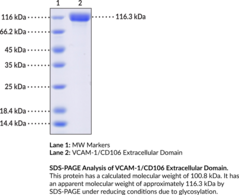
Vascular cell adhesion molecule 1 (VCAM-1), also known as CD106, is a member of the immunoglobulin (Ig) superfamily that is involved in the adhesion and migration of leukocytes and angiogenesis.1,2,3,4 It is composed of an extracellular domain, which may contain seven or six Ig-like repeats depending on the splice variant, a transmembrane domain, and a C-terminal domain.5,3 VCAM-1 is constitutively expressed in dendritic cells, monocyte-derived cells, and epithelial cells and in endothelium when induced by cytokines.1,2,5 It can be cleaved by disintegrin and metalloproteinase domain-containing protein 17 (ADAM17) and other metalloproteinases to release soluble VCAM-1 (sVCAM-1), which is a process known as shedding, and is induced by TNF-α, IL-1β, and other cytokines.3 Increased circulating levels of sVCAM-1 is associated with several diseases, including cancer, diabetes, sepsis, cardiovascular diseases, and preeclampsia, as well as parasitic infections.6,7,8,3,9,10 Cayman’s VCAM-1/CD106 Extracellular Domain (human, recombinant) protein can be used for cell-based adhesion assays. This protein is a disulfide-linked homodimer. The reduced monomer, composed of VCAM-1 (amino acids 25-697) fused to human IgG1 Fc at its C-terminus, consists of 911 amino acids, has a calculated molecular weight of 100.8 kDa, and a predicted N-terminus of Phe25 after signal peptide cleavage. As a result of glycosylation, the monomer migrates at approximately 116.3 kDa by SDS-PAGE under reducing conditions.
WARNING This product is not for human or veterinary use.
References & Product Citations
1. Soluble forms of vascular adhesion molecules, E-
2. Circulating adhesion molecules in disease. Immunol. Today 14, 506-512 (1993).
3. VCAM-
4. Angiogenesis mediated by soluble forms of E-
5. Gene structure, chromosomal location, and basis for alternative mRNA splicing of the human VCAM1 gene. Proc. Natl. Acad. Sci. USA 88(17), 7859-7863 (1991).
6. Circulating intercellular adhesion molecule-
7. Increased levels of plasma ELAM-
8. Increased circulating adhesion molecule concentrations in patients with the systemic inflammatory response syndrome: A prospective cohort study. Crit. Care Med. 22(4), 651-657 (1994).
9. The cell adhesion molecule, VCAM-
10. Increased plasma concentrations of sICAM-
Contact Info
Cayman Chemical1180 East Ellsworth RoadAnn Arbor, Michigan 48108 USAToll Free: (800) 364-9897(USA and Canada only)Fax: (734) 971-3640


