
Technical Support & Resources
Visit our FAQ
Contact Us
Toll Free Phone (USA and Canada Only): (888) 526-5351
Direct Phone: (734) 975-3888
Technical Information
- CD167 Antigen-like Family Member B
- CD167b
- Discoidin Domain-containing Receptor 2
- Discoidin Domain-containing Receptor Tyrosine Kinase 2
- Discoidin Domain Receptor 2
- Neurotrophic Tyrosine Kinase Receptor-related 3
- NTRKR3
Shipping & Storage Information
Recommended Products
Certificates of Analysis & Batch Specific Data
Provide batch numbers separated by commas to download or request available product inserts, QC sheets, certificates of analysis, data packs, and GC-MS data.
Kinase Resource Center
Discover Products & Resources for Kinase Research
- Kinase inhibitors, screening libraries, assay kits, & more
- Tools to study kinase signaling pathways:
- Growth factor signaling
- PI3K/Akt/mTOR
- MAPKs (ERK, p38, & JNK)
- JAK/STAT signaling
- Articles, resources, & advice
Product Description
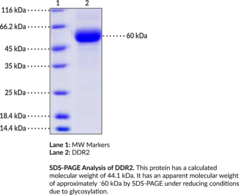
Discoidin domain-containing receptor 2 (DDR2), also known as CD167b, is a receptor tyrosine kinase (RTK) with roles in microenvironmental sensing and the physiological and pathological processes regulated by collagen remodeling.1,2,3 It is composed of an extracellular discoidin domain, discoidin-like domain, and juxtamembrane domain, a transmembrane domain, and an intracellular juxtamembrane domain and kinase domain.2,3 DDR2 is expressed in mesenchymal cells, including fibroblasts, myofibroblasts, smooth muscle cells, and chondrocytes, as well as in circulating human neutrophils, and localizes to the cell membrane. Unlike most RTKs that bind soluble ligands, DDR binds to collagen monomers, including type I, II, III, and V fibrillar collagen and non-fibrillar type X collagen.1 Collagen binding induces autophosphorylation of the intracellular juxtamembrane and kinase domains and recruitment of various proteins to facilitate signal transduction. DDR2 is associated with cartilage and bone damage in patients with rheumatoid arthritis.2 DDR2 is overexpressed in various cancers, including non-small cell lung cancer (NSCLC), Hodgkin lymphoma, prostate cancer, thyroid carcinoma, and nasopharyngeal carcinomas. Cayman’s DDR2 (human, recombinant) protein consists of 389 amino acids, has a calculated molecular weight of 44.1 kDa, and a predicted N-terminus of Lys22 after signal peptide cleavage. By SDS-PAGE, under reducing conditions, the apparent molecular mass of the protein is ~60 kDa due to glycosylation.
WARNING This product is not for human or veterinary use.
References & Product Citations
1. .
2. .
3. .
Contact Info
Cayman Chemical1180 East Ellsworth RoadAnn Arbor, Michigan 48108 USAToll Free: (800) 364-9897(USA and Canada only)Fax: (734) 971-3640


