
Technical Support & Resources
Visit our FAQ
Contact Us
Toll Free Phone (USA and Canada Only): (888) 526-5351
Direct Phone: (734) 975-3888
Product Categories
Application
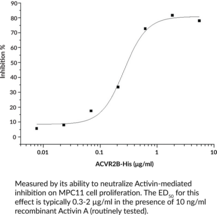
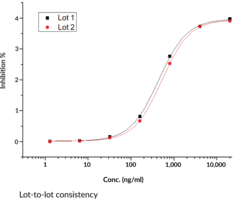
Technical Information
- Activin RIIB
- Activin Receptor Type IIB
- Activin Receptor Type-2B
- ACTR-IIB
- ACVR2B
- AVR2B
Shipping & Storage Information
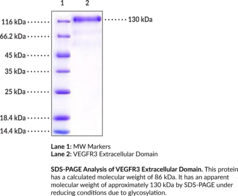
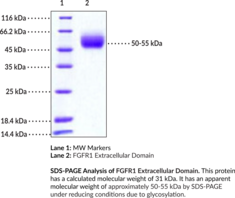
Certificates of Analysis & Batch Specific Data
Provide batch numbers separated by commas to download or request available product inserts, QC sheets, certificates of analysis, data packs, and GC-MS data.
Kinase Resource Center
Discover Products & Resources for Kinase Research
- Kinase inhibitors, screening libraries, assay kits, & more
- Tools to study kinase signaling pathways:
- Growth factor signaling
- PI3K/Akt/mTOR
- MAPKs (ERK, p38, & JNK)
- JAK/STAT signaling
- Articles, resources, & advice
Product Description
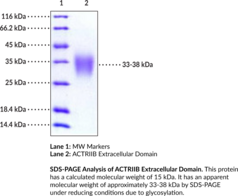
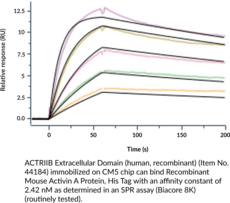
Activin receptor type IIB (ACTRIIB) is a type II activin receptor and member of the TGF-β receptor superfamily.1,2 It is composed of an extracellular ligand-binding domain, a transmembrane domain, an intracellular kinase domain, and a C-terminal tail.2 ACTRIIB is ubiquitously expressed in fetal development with the highest expression in the brain and spinal cord and is enriched in adult skeletal muscle.3,4 ACTRIIB has several ligands, including activins, growth differentiation factor 8 (GDF8), also known as myostatin, and bone morphogenetic proteins (BMPs).2 Upon ligand binding, ACTRIIB forms a complex with type I activin receptors, which results in their activation and signaling via the SMAD pathway. ACTRIIB is involved in hematopoiesis, myogenesis, and bone formation and resorption.5 Mutations in the gene encoding ACTRIIB, ACVR2B, are associated with left-right axis malformations.6 Formulations containing a fusion protein of the ACTRIIB ligand-binding domain with the Fc of an immunoglobulin have been used as erythroid maturation agents in the treatment of anemia in patients with β-thalassemia or myelodysplastic syndrome (MDS). Cayman’s ACTRIIB Extracellular Domain (human, recombinant) protein can be used for binding assay and cell-based assay applications. This protein consists of 127 amino acids, has a calculated molecular weight of 15 kDa, and a predicted N-terminus of Ser19 after signal peptide cleavage. By SDS-PAGE, under reducing conditions, the apparent molecular mass of the protein is 33-38 kDa due to glycosylation.
WARNING This product is not for human or veterinary use.
References & Product Citations
1. Activation of signalling by the activin receptor complex. Mol. Cell. Biol. 16(3), 1066-1073 (1996).
2. Activin Receptor Signaling. Encyclopedia of Hormones 17-23 (2003).
3. Expression of type II activin receptor genes during differentiation of human K562 cells and cDNA cloning of the human type IIB activin receptor. Blood 83(8), 2163-2170 (1994).
4. Myostatin/activin pathway antagonism: molecular basis and therapeutic potential. Int. J. Biochem. Cell Biol. 45(10), 2333-2347 (2013).
5. Principles of the activin receptor signaling pathway and its inhibition. Cytokine Growth Factor Rev. 60, 1-17 (2021).
6. Left-
Contact Info
Cayman Chemical1180 East Ellsworth RoadAnn Arbor, Michigan 48108 USAToll Free: (800) 364-9897(USA and Canada only)Fax: (734) 971-3640


