
Technical Support & Resources
Visit our FAQ
Contact Us
Toll Free Phone (USA and Canada Only): (888) 526-5351
Direct Phone: (734) 975-3888
Product Categories
Technical Information
- UFO
Shipping & Storage Information
Recommended Products
Certificates of Analysis & Batch Specific Data
Provide batch numbers separated by commas to download or request available product inserts, QC sheets, certificates of analysis, data packs, and GC-MS data.
Kinase Resource Center
Discover Products & Resources for Kinase Research
- Kinase inhibitors, screening libraries, assay kits, & more
- Tools to study kinase signaling pathways:
- Growth factor signaling
- PI3K/Akt/mTOR
- MAPKs (ERK, p38, & JNK)
- JAK/STAT signaling
- Articles, resources, & advice
Product Description
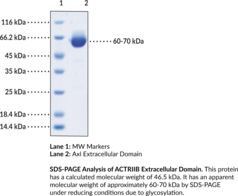
Axl is a receptor tyrosine kinase and member of the TAM kinase family.1,2 It is composed of two immunoglobulin-like (Ig-like) domains, two fibronectin-like III domains, an extracellular cleavage site, a transmembrane region, and a C-terminal kinase domain.1 It is ubiquitously expressed and localizes to the cell membrane.3,4 After homodimerization, Axl is activated by growth arrest-specific protein 6 (GAS6) and is involved in promoting proliferation and hematopoietic lineage differentiation and negatively regulating antigen-presenting cell activation.2,5,1 The extracellular domain of Axl can be cleaved by metalloproteinases, releasing soluble Axl to bind and activate membrane-associated Axl.4,3 In cancer, Axl promotes metastasis, epithelial-to-mesenchymal transition (EMT), and survival.1 Increased expression of AXL is associated with shorter progression-free survival in patients with non-small cell lung cancer (NSCLC).6 Cayman's Axl Extracellular Domain (human, recombinant) protein can be used for binding assays. This protein consists of 428 amino acids, has a calculated molecular weight of 46.5 kDa, and a predicted N-terminus of Glu33 after signal peptide cleavage. By SDS-PAGE, under reducing conditions, the apparent molecular mass of the protein is 60-70 kDa due to glycosylation.
WARNING This product is not for human or veterinary use.
References & Product Citations
1. The TAM family: Phosphatidylserine sensing receptor tyrosine kinases gone awry in cancer. Nat. Rev. Cancer 14(12), 769-785 (2014).
2. Axl as a mediator of cellular growth and survival. Oncotarget. 5(19), 8818-8852 (2014).
3. Targeting Axl and Mer kinases in cancer. Mol. Cancer Ther. 10(10), 1763-1773 (2016).
4. TAM receptor pathways at the crossroads of neuroinflammation and neurodegeneration. Dis. Markers 2387614 (2019).
5. Targeting Tyro3, Axl and MerTK (TAM receptors): Implications for macrophages in the tumor microenvironment. Mol. Cancer 18(1), 94 (2019).
6. High levels of AXL expression in untreated EGFR-
Contact Info
Cayman Chemical1180 East Ellsworth RoadAnn Arbor, Michigan 48108 USAToll Free: (800) 364-9897(USA and Canada only)Fax: (734) 971-3640


