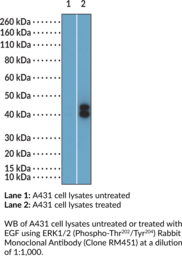
A biotinylated ERK1/2 (phospho-Thr202/Tyr204) peptide
Technical Support & Resources

Information provided in the product description is from published literature. Due to the nature of scientific experimentation, your results (e.g., selectivity and effective concentrations) or specific application for this product may differ. If you have questions about how this product fits your application, please contact our technical support staff.

Visit our FAQ

Contact Us

Toll Free Phone (USA and Canada Only): (888) 526-5351
Direct Phone: (734) 975-3888

Request Technical Support

Technical Support Request

To streamline the process attach the appropriate questionnaire to your inquiry.

Download IHC QuestionnaireDownload WB Questionnaire

View Our Privacy Statement for details on how we use and protect your data. In addition, this site is protected by hCaptcha and its Privacy Policy and Terms of Service apply.

ERK1/2 (Phospho-Thr202/Tyr204)-biotin Peptide (trifluoroacetate salt)

Item No. 44663

Technical Information
Formal Name
(2S,5S,8S,11S,14S,17S,20S,23S,26S,29S)-29-((2S,5S,8S,14S,17S)-17-((1H-imidazol-5-yl)methyl)-8-benzyl-14-((R)-1-hydroxyethyl)-5-isobutyl-4,7,10,13,16,19-hexaoxo-23-((3aS,4S,6aR)-2-oxohexahydro-1H-thieno[3,4-d]imidazol-4-yl)-2-((R)-1-(phosphonooxy)ethyl)-3,6,9,12,15,18-hexaazatricosanamido)-11-((1H-indol-3-yl)methyl)-5,14-bis(3-guanidinopropyl)-8-(4-hydroxybenzyl)-17-((R)-1-hydroxyethyl)-23-isopropyl-2,20-dimethyl-4,7,10,13,16,19,22,25,28-nonaoxo-26-(4-(phosphonooxy)benzyl)-3,6,9,12,15,18,21,24,27-nonaazadotriacontanedioic acid, trifluoroacetate salt
Synonyms
  • Biotin-ERK1/2 (Phospho-Thr202/Tyr204) Peptide
  • Biotin-ERK1/2-Thr202/Tyr204 Peptide
Molecular Formula
C102H147N27O32P2S • XCF3COOH
Formula Weight
Purity
≥95%
A solid
Peptide Sequence
Biotin-HTGFL-pT-E-pY-VATRWYRA-OH
DMSO: Soluble: ≥10 mg/mlPBS (pH 7.2): Sparingly soluble: 1-10 mg/ml
SMILES
OC([C@@H](NC([C@H](CCCNC(N)=N)NC([C@@H](NC([C@@H](NC([C@H](CCCNC(N)=N)NC([C@@]([C@H](O)C)([H])NC([C@@H](NC([C@H](C(C)C)NC([C@@H](NC([C@H](CCC(O)=O)NC([C@]([H])([C@H](OP(O)(O)=O)C)NC([C@H](CC(C)C)NC([C@@H](NC(CNC([C@@]([C@H](O)C)([H])NC([C@@H](NC(CCCC[C@H]1[C@@]2([H])NC(N[C@]2(CS1)[H])=O)=O)CC3=CN=CN3)=O)=O)=O)CC4=CC=CC=C4)=O)=O)=O)=O)CC(C=C5)=CC=C5OP(O)(O)=O)=O)=O)C)=O)=O)=O)CC6=CNC7=C6C=CC=C7)=O)CC(C=C8)=CC=C8O)=O)=O)C)=O.OC(C(F)(F)F)=O
InChi Code
InChI=1S/C102H147N27O32P2S.C2HF3O2/c1-50(2)39-69(120-89(141)70(40-57-19-11-10-12-20-57)116-78(134)47-111-95(147)81(54(7)130)127-94(146)74(44-61-46-107-49-112-61)115-77(133)26-16-15-25-76-84-75(48-164-76)124-102(153)129-84)92(144)128-83(56(9)160-162(154,155)156)98(150)119-68(35-36-79(135)136)88(140)121-72(42-59-29-33-63(34-30-59)161-163(157,158)159)93(145)125-80(51(3)4)96(148)113-52(5)85(137)126-82(55(8)131)97(149)118-67(24-18-38-109-101(105)106)87(139)123-73(43-60-45-110-65-22-14-13-21-64(60)65)91(143)122-71(41-58-27-31-62(132)32-28-58)90(142)117-66(23-17-37-108-100(103)104)86(138)114-53(6)99(151)152;3-2(4,5)1(6)7/h10-14,19-22,27-34,45-46,49-56,66-76,80-84,110,130-132H,15-18,23-26,35-44,47-48H2,1-9H3,(H,107,112)(H,111,147)(H,113,148)(H,114,138)(H,115,133)(H,116,134)(H,117,142)(H,118,149)(H,119,150)(H,120,141)(H,121,140)(H,122,143)(H,123,139)(H,125,145)(H,126,137)(H,127,146)(H,128,144)(H,135,136)(H,151,152)(H4,103,104,108)(H4,105,106,109)(H2,124,129,153)(H2,154,155,156)(H2,157,158,159);(H,6,7)/t52-,53-,54+,55+,56+,66-,67-,68-,69-,70-,71-,72-,73-,74-,75-,76-,80-,81-,82-,83-,84-;/m0./s1
InChi Key
HOCBCIRMLDIHQM-HHCYHYKASA-N
Shipping & Storage Information
Storage
-20°C
Shipping
Room temperature in continental US; may vary elsewhere
Certificates of Analysis & Batch Specific Data

Provide batch numbers separated by commas to download or request available product inserts, QC sheets, certificates of analysis, data packs, and GC-MS data.

    Add

    Add

    Add

    Kinase Resource Center
    Discover Products & Resources for Kinase Research
    • Kinase inhibitors, screening libraries, assay kits, & more
    • Tools to study kinase signaling pathways:
      • Growth factor signaling
      • PI3K/Akt/mTOR
      • MAPKs (ERK, p38, & JNK)
      • JAK/STAT signaling
    • Articles, resources, & advice
    EXPLORE NOW
    Product Description

    ERK1/2 (phospho-Thr202/Tyr204)-biotin peptide is a biotinylated and phosphorylated peptide fragment corresponding to amino acids 197 to 212 of ERK1 and 180 to 195 of ERK2. ERK1 and ERK2, also known as ERK1/2, are serine/threonine protein kinases and essential components of the MAP kinase signaling cascade.1 Upon extracellular stimulation with mitogens, growth factors, or cytokines, the MAP kinase signaling cascade is initiated and terminates with dual phosphorylation of ERK1 and ERK2 in the activation segment's activation lip at Thr202/Tyr204 or Thr185/Tyr187, respectively, by MEK1/2.1,2,3,4 Upon activation, ERK1/2 phosphorylate and activate substrates in the cytosol or various subcellular compartments, including the nucleus where they induce activation of transcription factors involved in cell proliferation, differentiation, and the stress response.2,3,5,6 This product can be used in the detection of antibodies targeting ERK1/2 (phospho-Thr202/Tyr204) in biological samples.

    WARNING This product is not for human or veterinary use.

    References & Product Citations
    Product Description References

    1. Roskoski, R., Jr. ERK1/2 MAP kinases: Structure, function, and regulation. Pharm. Res. 66(2), 105-143 (2012).

    2. Santarpia, L., Lippman, S.L., and El-Naggar, A.K. Targeting the mitogen-activated protein kinase RAS-RAF signaling pathway in cancer therapy. Expert. Opin. Ther. Targets 16(1), 103-119 (2012).

    3. Guo, Y.-J., Pan, W.-W., Liu, S.-B., et al. ERK/MAPK signalling pathway and tumorigenesis. Exp. Ther. Med. 19(3), 1997-2007 (2020).

    4. Buscá, R., Pouysségur, J., and Lenormand, P. ERK1 and ERK2. Encyclopedia of signaling molecules (2018).

    5. Lenormand, P., Brondello, J.-M., Brunet, A., et al. Growth factor-induced p42/p44 MAPK nuclear translocation and retention requires both MAPK activation and neosynthesis of nuclear anchoring proteins. J. Cell Biol. 142(3), 625-633 (1998).

    6. Brunet, A., Roux, D., Lenormand, P., et al. Nuclear translocation of p42/p44 mitogen-activated protein kinase is required for growth factor-induced gene expression and cell cycle entry. EMBO J. 18(3), 664-674 (1999).