
Technical Support & Resources
Visit our FAQ
Contact Us
Toll Free Phone (USA and Canada Only): (888) 526-5351
Direct Phone: (734) 975-3888
Product Categories
Product Type
Research Area
Technical Information
- AChE
Shipping & Storage Information
Recommended Products
Certificates of Analysis & Batch Specific Data
Provide batch numbers separated by commas to download or request available product inserts, QC sheets, certificates of analysis, data packs, and GC-MS data.
Product Description
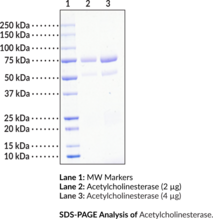
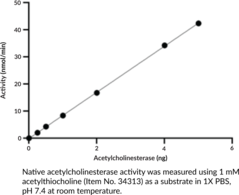
Acetylcholinesterase (AChE) is a highly conserved homotetrameric carboxylesterase that is composed of four ~70 kDa subunits, each containing a single active site.1,2,3 In the electric eel (E. electricus), AChE is highly expressed in the electric organs at the posterior innervated membrane, where it hydrolyzes acetylcholine to acetate and choline to terminate synaptic transmission between electromotor neurons and electrocytes.4 AChE has commonly been used in biomedical research in assays, such as ELISA, for the detection or quantification of target molecules.5 It has also been used in the detection of organophosphate and carbamate pesticides due to their ability to inhibit AChE activity. Cayman’s Acetylcholinesterase (eel) protein can be used for ELISA, enzyme activity assay, and Western blot applications.
WARNING This product is not for human or veterinary use.
References & Product Citations
1. Butyrylcholinesterase: A multifaceted pharmacological target and tool. Curr. Protein Pept. Sci. 21(1), 99-109 (2020).
2. Fine structure of electric eel acetylcholinesterase. Brain Res. 88(1), 127-130 (1975).
3. Structure of 11S acetylcholinesterase. Subunit composition. Biochemistry 13(15), 3068-3079 (1974).
4. Electrophorus electricus as a model system for the study of membrane excitability. Comp. Biochem. Physiol. A Mol. Integr. Physiol. 119(1), 225-241 (1998).
5. Recent advances in colorimetric strategies for acetylcholinesterase assay and their applications. Trends Analyt. Chem. 142, 116320 (2021).
Contact Info
Cayman Chemical1180 East Ellsworth RoadAnn Arbor, Michigan 48108 USAToll Free: (800) 364-9897(USA and Canada only)Fax: (734) 971-3640


