
Technical Support & Resources
Visit our FAQ
Contact Us
Toll Free Phone (USA and Canada Only): (888) 526-5351
Direct Phone: (734) 975-3888
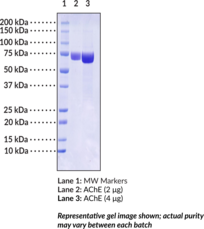
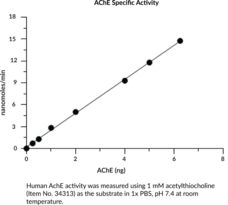
Technical Information
- AChE
- AcChoEase
- ARACHE
- EC 3.1.1.7
Shipping & Storage Information
Recommended Products
Certificates of Analysis & Batch Specific Data
Provide batch numbers separated by commas to download or request available product inserts, QC sheets, certificates of analysis, data packs, and GC-MS data.

Explore Obesity & Metabolic Disease Resources
Discover high-quality research tools to investigate GLP-1 mechanisms and next-generation metabolic targets.
OBESITY RESEARCH SOLUTIONSProduct Description
Acetylcholinesterase (AChE) is a highly conserved homotetrameric carboxylesterase that is composed of four ~70 kDa subunits with each subunit containing a single active site.1,2 It is primarily found at neuromuscular junctions and in the brain at cholinergic synapses, where it hydrolyzes acetylcholine to acetate and choline to terminate synaptic transmission.3,4 AChE can be bound to the extracellular side of the plasma membrane via a proline-rich membrane anchor (PRiMA) on neuronal synapses but can also be linked to the outer membrane of erythrocytes.3 It accelerates amyloid-β (Aβ) fibrillogenesis in vitro, and overexpression of AChE accelerates Aβ plaque formation and disease progression in the Tg2576 transgenic mouse model of Alzheimer's disease.5 AChE activity is also increased in islets of Langerhans in rats with diabetes induced by streptozotocin (Item No. 13104). Cayman's Acetylcholinesterase (human, recombinant) protein can be used for ELISA, enzyme activity assay, and Western blot (WB) applications.
WARNING This product is not for human or veterinary use.
References & Product Citations
1. Flexibility of aromatic residues in the active-
2. Fine structure of electric eel acetylcholinesterase. Brain Res. 88(1), 127-130 (1975).
3. Phenolic lipids affect the activity and conformation of acetylcholinesterase from Electrophorus electricus (Electric eel). Nutrients 6(5), 1823-1831 (2014).
4. Assessment of acetylcholinesterase activity using indoxylacetate and comparison with the standard Ellman’s method. Int. J. Mol. Sci. 12(4), 2631-2640 (2011).
5. Status of acetylcholinesterase and butyrylcholinesterase in Alzheimer’s disease and type 2 diabetes mellitus. CNS Neurol. Disord. Drug Target 13(8), 1432-1439 (2014).
Contact Info
Cayman Chemical1180 East Ellsworth RoadAnn Arbor, Michigan 48108 USAToll Free: (800) 364-9897(USA and Canada only)Fax: (734) 971-3640


