
Technical Support & Resources
Visit our FAQ
Contact Us
Toll Free Phone (USA and Canada Only): (888) 526-5351
Direct Phone: (734) 975-3888
Product Categories
Histone H3 (Citrullinated R2 + R8 + R17) Monoclonal Antibody - Biotinylated (Clone 11D3)
Item No. 44743
Technical Information
Shipping & Storage Information
Recommended Products
Certificates of Analysis & Batch Specific Data
Provide batch numbers separated by commas to download or request available product inserts, QC sheets, certificates of analysis, data packs, and GC-MS data.

Visit Our Cancer Resource Center
Find Tools & Resources to Study the Hallmarks of Cancer
- Cancer cell signaling & regulation
- Cancer metabolism
- Tumor microenvironment
Product Description
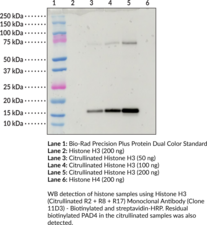
Histone H3 is a nuclear protein and a component of the nucleosome core that is essential for organizing genomic DNA in eukaryotic nuclei.1 It is a globular protein that contains an unstructured N-terminal tail that extends outside of the nucleosome core and is subject to various post-translational modifications, including citrullination. Histone H3 is subject to citrullination of arginine residues by peptidyl arginine deiminase 4 (PAD4) at positions 2, 8, 17, and 26, and this citrullination blocks methylation of these residues by protein-arginine methyltransferase 4 (PRMT4) and modulates the transcription of target genes. Histone H3 is subject to citrullination by protein-arginine deiminase 4 (PAD4) at arginine 2 (R2), R8, and R17 during neutrophil extracellular trap formation (NETosis).2 Citrullination of histone H3 at these residues reduces the positive charge of histone H3 and leads to decondensed chromatin, which is expelled into the extracellular space when the neutrophil membrane ruptures.3,2 Citrullinated histone H3 is a component of neutrophil extracellular traps (NETs) that acts as an autoantigen to induce production of anti-citrullinated protein antibodies (ACPAs) associated with various diseases such as sepsis, multiple sclerosis, rheumatoid arthritis, and multiple myeloma.1,4,5,6 Increased serum levels of histone H3 citrullinated at R2, R8, and R17 have been found in patients with asthma and in septic shock patients, where they are positively associated with a sequential organ failure assessment (SOFA) score and poor survival.7,8 Sputum levels of histone H3 citrullinated at R2, R8, and R17 are increased in patients with rheumatoid arthritis, as well as in individuals identified as at risk for developing rheumatoid arthritis based on their seropositivity for IgA ACPAs.9 Cayman’s Histone H3 (Citrullinated R2 + R8 + R17) Monoclonal Antibody (Clone 11D3) - Biotinylated can be used for ELISA and Western blot (WB) applications.
WARNING This product is not for human or veterinary use.
References & Product Citations
1. Posttranslational modifications of human histone H3: An update. Proteomics 14(17-18), 2047-2060 (2014).
2. Histone hypercitrullination mediates chromatin decondensation and neutrophil extracellular trap formation. J. Cell Biol. 184(2), 205-213 (2009).
3. Quantification of citrullinated histone H3 bound DNA for detection of neutrophil extracellular traps. Cancers (Basel) 12(11), 3424 (2020).
4. Citrullinated histone H3: A novel target for the treatment of sepsis. Surgery 156(2), 229-234 (2014).
5. The role of citrullinated proteins suggests a novel mechanism in the pathogenesis of multiple sclerosis. Neurochem. Res. 32(2), 251-256 (2007).
6. Citrullination of histone H3 drives IL-
7. Citrullinated histone H3, a marker of extracellular trap formation, is increased in blood of stable asthma patients. Clin. Transl. Allergy 10, 31 (2020).
8. Serum citrullinated histone H3 concentrations differentiate patients with septic verses non-
9. Association of sputum neutrophil extracellular trap subsets with IgA anti-
Contact Info
Cayman Chemical1180 East Ellsworth RoadAnn Arbor, Michigan 48108 USAToll Free: (800) 364-9897(USA and Canada only)Fax: (734) 971-3640


