
Technical Support & Resources
Visit our FAQ
Contact Us
Toll Free Phone (USA and Canada Only): (888) 526-5351
Direct Phone: (734) 975-3888
Product Categories
Product Type
Technical Information
- Raptin Hormone Derived From RCN2
- C-terminus Cleaved From Reticulocalbin-2 (RCN2) (25-246)
Shipping & Storage Information
Recommended Products
Certificates of Analysis & Batch Specific Data
Provide batch numbers separated by commas to download or request available product inserts, QC sheets, certificates of analysis, data packs, and GC-MS data.

Explore Obesity & Metabolic Disease Resources
Discover high-quality research tools to investigate GLP-1 mechanisms and next-generation metabolic targets.
OBESITY RESEARCH SOLUTIONSProduct Description
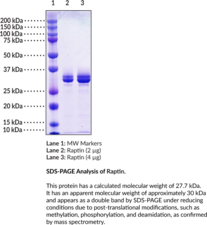
Raptin is a sleep-inducible hormone and C-terminal fragment of reticulocalbin-2 (RCN2) with roles in food intake and obesity prevention in animal models.1 RCN2 is predominantly expressed by neurons in the paraventricular nucleus (PVN) of the hypothalamus, and this expression is increased during the sleep phase compared to the active phase in mice. During the sleep period, activation of suprachiasmatic nucleus arginine vasopressin neurons (SCNAVPs) induces kallikrein-mediated Raptin cleavage from RCN2 and its secretion, an effect that is decreased by sleep deficiency. Raptin binds to metabotropic glutamate receptor 3 (mGluR3) in hypothalamic and gastric neurons to reduce appetite and gastric emptying, respectively. PVN-specific knockout of Rcn2 increases food intake and decreases energy expenditure in mice fed a high-fat diet. Plasma levels of Raptin are negatively correlated with sleep deficiency and obesity in humans, and a heterozygous RCN2 nonsense variant is associated with lower Raptin levels during the sleep phase and hyperphagia. Cayman's Raptin (human, recombinant) protein can be used for binding assay, ELISA, and Western blot (WB) applications.
WARNING This product is not for human or veterinary use.
References & Product Citations
1. Raptin, a sleep-
Contact Info
Cayman Chemical1180 East Ellsworth RoadAnn Arbor, Michigan 48108 USAToll Free: (800) 364-9897(USA and Canada only)Fax: (734) 971-3640


