
Technical Support & Resources
Information provided in the product description is from published literature. Due to the nature of scientific experimentation, your results (e.g., selectivity and effective concentrations) or specific application for this product may differ. If you have questions about how this product fits your application, please contact our technical support staff.
Visit our FAQ
Contact Us
Toll Free Phone (USA and Canada Only): (888) 526-5351
Direct Phone: (734) 975-3888
Product Categories
Product Type
Technical Information
- ABS 205
- (±)-2-Propyl-4-pentynoate
- (±)-4-yne Valproic Acid
- (±)-4-yn-VPA
Shipping & Storage Information
Recommended Products
Certificates of Analysis & Batch Specific Data
Provide batch numbers separated by commas to download or request available product inserts, QC sheets, certificates of analysis, data packs, and GC-MS data.
Product Description
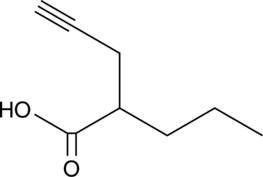
(±)-4-yn-Valproic acid ((±)-4-yn-VPA) is an alkyne-containing derivative of valproic acid (Item Nos. 35739 | 13033) and a racemic mixture of (R)- and (S)-4-yn-VPA. (±)-4-yn-VPA increases the levels of neural cell adhesion molecule (NCAM) in F9 embryonic stem cells in a stereoselective manner, with only (S)-4-yn-VPA increasing NCAM levels.1 It also has stereospecific teratogenic effects in vivo, including inducing exencephaly in mice, with (S)-4-yn-VPA having a higher teratogenic potential than (R)-4-yn-VPA.2 (±)-4-yn-VPA increases the seizure threshold in the pentylenetetrazole (PTZ; Item No. 18682) seizure threshold test in mice (ED50 = 1.78 mmol/kg), an effect that is independent of stereochemistry.3
WARNING This product is not for human or veterinary use.
References & Product Citations
1. Modulation of peroxisome proliferator-
2. Valproic acid-
3. On the development of alternative antiepileptic drugs. Naturwissenschaften 78, 272-274 (1991).
Contact Info
Cayman Chemical1180 East Ellsworth RoadAnn Arbor, Michigan 48108 USAToll Free: (800) 364-9897(USA and Canada only)Fax: (734) 971-3640


