
Technical Support & Resources
Visit our FAQ
Contact Us
Toll Free Phone (USA and Canada Only): (888) 526-5351
Direct Phone: (734) 975-3888
Product Categories
Application
Technical Information
- Casitas B-lineage Lymphoma Proto-oncogene C
- CBLC
- Cbl-3
- Cbl Proto-oncogene C
- Cbl-SL
- RNF57
- RING Finger Protein 57
- E3 Ubiquitin-protein Ligase Cbl-c
Shipping & Storage Information
Recommended Products
Certificates of Analysis & Batch Specific Data
Provide batch numbers separated by commas to download or request available product inserts, QC sheets, certificates of analysis, data packs, and GC-MS data.
Kinase Resource Center
Discover Products & Resources for Kinase Research
- Kinase inhibitors, screening libraries, assay kits, & more
- Tools to study kinase signaling pathways:
- Growth factor signaling
- PI3K/Akt/mTOR
- MAPKs (ERK, p38, & JNK)
- JAK/STAT signaling
- Articles, resources, & advice
Product Description
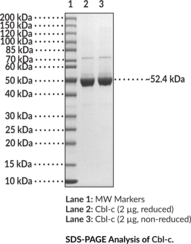
Casitas B-lineage lymphoma proto-oncogene C (Cbl-c) is a member of the Cbl RING-type E3 ubiquitin ligase family.1 It is composed of an N-terminal tyrosine kinase-binding domain, which contains a helix bundle, an EF hand calcium-binding motif, and a variant Src homology 2 (SH2) domain, a linker region, a RING finger domain, and a proline-rich region.2,3 Cbl-c is autoinhibited by its EF hand and SH2 domain but is activated following Tyr341 phosphorylation by Src.2 It is expressed in colon, small intestine, pancreas, placenta, liver, kidney, and prostate.3 Cbl-c is involved in the negative regulation of receptor tyrosine kinases, including EGFR and Fyn.1,3 Intratumoral levels of Cbl-c are increased in patients with colorectal cancer and loss-of-function mutations in CBLC are associated with several cancers.4,5 Cayman’s Cbl-c (human, recombinant) protein can be used for enzyme activity assays, structural biology, and biophysical applications and has a calculated molecular weight of 52.4 kDa.
WARNING This product is not for human or veterinary use.
References & Product Citations
1. Negative regulation of receptor tyrosine kinases by ubiquitination: Key roles of the Cbl family of E3 ubiquitin ligases. Front. Endocrinol. (Lausanne) 13, 971162 (2022).
2. The N terminus of Cbl-
3. Molecular cloning and characterization of a novel cbl-
4. CBLC promotes the development of colorectal cancer by promoting ABI1 degradation to activate the ERK signaling pathway. Transl. Oncol. 45, 101992 (2024).
5. Loss of function Cbl-
Contact Info
Cayman Chemical1180 East Ellsworth RoadAnn Arbor, Michigan 48108 USAToll Free: (800) 364-9897(USA and Canada only)Fax: (734) 971-3640


