
Technical Support & Resources
Information provided in the product description is from published literature. Due to the nature of scientific experimentation, your results (e.g., selectivity and effective concentrations) or specific application for this product may differ. If you have questions about how this product fits your application, please contact our technical support staff.
Visit our FAQ
Contact Us
Toll Free Phone (USA and Canada Only): (888) 526-5351
Direct Phone: (734) 975-3888
Product Categories
Technical Information
Shipping & Storage Information
Recommended Products
Certificates of Analysis & Batch Specific Data
Provide batch numbers separated by commas to download or request available product inserts, QC sheets, certificates of analysis, data packs, and GC-MS data.

Visit Our Environmental Toxicology Resource Center
Explore additional resources to study natural toxins, pollutants including PFAS and 6-PPD-Q, and their biological effects.
ENVIRONMENTAL TOXICOLOGY TOOLS & SERVICESProduct Description
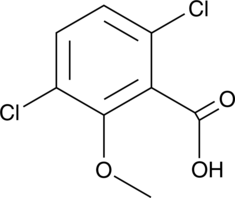
Dicamba is an herbicide.1 It reduces mitochondrial membrane potential and inhibits ATP synthase in rat liver homogenates.2 Dicamba increases the frequency of teratogenic effects in zebrafish embryos.3 It has been found in surface water, ground water, and soil.1 Formulations containing dicamba have been used in the management of broadleaf weeds.
WARNING This product is not for human or veterinary use.
References & Product Citations
1. Environmental fate and effects of dicamba: A Canadian perspective. Rev. Environ. Contam. Toxicol. 133, 1-58 (1993).
2. The herbicide dicamba (2-
3. Teratogenic effects of the dicamba herbicide in Zebrafish (Danio rerio) embryos. Environ. Pollut. 334, 122187 (2023).
Contact Info
Cayman Chemical1180 East Ellsworth RoadAnn Arbor, Michigan 48108 USAToll Free: (800) 364-9897(USA and Canada only)Fax: (734) 971-3640


