
Technical Support & Resources
Information provided in the product description is from published literature. Due to the nature of scientific experimentation, your results (e.g., selectivity and effective concentrations) or specific application for this product may differ. If you have questions about how this product fits your application, please contact our technical support staff.
Visit our FAQ
Contact Us
Toll Free Phone (USA and Canada Only): (888) 526-5351
Direct Phone: (734) 975-3888
Product Categories
Research Area
Technical Information
Shipping & Storage Information
Recommended Products
Certificates of Analysis & Batch Specific Data
Provide batch numbers separated by commas to download or request available product inserts, QC sheets, certificates of analysis, data packs, and GC-MS data.

Visit Our Cancer Resource Center
Find Tools & Resources to Study the Hallmarks of Cancer
- Cancer cell signaling & regulation
- Cancer metabolism
- Tumor microenvironment
Product Description
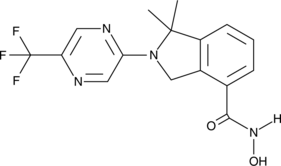
FT895 is an inhibitor of histone deacetylase 11 (HDAC11; IC50 = 3 nM).1 It is selective for HDAC11 over HDAC1-7 (IC50s = >10,000 nM for all), HDAC8 (IC50 = 5,600 nM), and HDAC9-10 (IC50s = >10,000 nM for both). FT895 induces cytotoxicity in Hs 53.T neurofibroma and S462.TY malignant peripheral nerve sheath tumor (MPNST) cells (IC50s = 13.12 and 6.76 µM, respectively).2 It increases the levels of reactive oxygen species (ROS) in S462.TY cells at 10 µM and reduces mitochondrial basal and maximal respiration at 10 and 20 µM in the same cells.3 FT895 (0.5 mg/kg) enhances the reduction in tumor size induced by cordycepin (Item No. 14426) in an S462.TY mouse xenograft model.2 It also increases the production of nitric oxide (NO) in human monocyte-derived macrophages infected with heat-killed C. albicans. FT895 (50 mg/kg) reduces renal inflammation and fungal burden and increases survival in a mouse model of C. albicans infection.4
WARNING This product is not for human or veterinary use.
References & Product Citations
1. Discovery of novel N-
2. A novel HDAC11 inhibitor potentiates the tumoricidal effects of cordycepin against malignant peripheral nerve sheath tumor through the Hippo signaling pathway. Am. J. Cancer Res. 12(2), 873-892 (2022).
3. FT895 Impairs mitochondrial function in malignant peripheral nerve sheath tumor cells. Int. J. Mol. Sci. 25(1), 277 (2023).
4. HDAC11 negatively regulates antifungal immunity by inhibiting Nos2 expression via binding with transcriptional repressor STAT3. Redox Biol. 56, 102461 (2022).
Contact Info
Cayman Chemical1180 East Ellsworth RoadAnn Arbor, Michigan 48108 USAToll Free: (800) 364-9897(USA and Canada only)Fax: (734) 971-3640


