A derivative of insulin
Technical Support & Resources

Information provided in the product description is from published literature. Due to the nature of scientific experimentation, your results (e.g., selectivity and effective concentrations) or specific application for this product may differ. If you have questions about how this product fits your application, please contact our technical support staff.

Visit our FAQ

Contact Us

Toll Free Phone (USA and Canada Only): (888) 526-5351
Direct Phone: (734) 975-3888
Request Technical Support

Technical Support Request

To streamline the process attach the appropriate questionnaire to your inquiry.

Download IHC QuestionnaireDownload WB Questionnaire

View Our Privacy Statement for details on how we use and protect your data. In addition, this site is protected by hCaptcha and its Privacy Policy and Terms of Service apply.

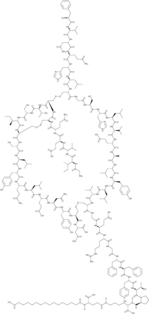
Insulin degludec

Item No. 46122

Technical Information
Formal Name
29B-[N6-[N-(15-carboxy-1 oxopentadecyl)-L-γ-glutamyl]-L-lysine]-(1A-21A),(1B-29B)-insulin (human)
CAS Number
844439-96-9
Synonyms
  • IDeg
Molecular Formula
C274H411N65O81S6
Formula Weight
Purity
≥98%
A solid
SMILES
CC[C@@H]([C@H]1C(N[C@H]2CSSC[C@H](NC([C@@H](NC([C@@H](NC([C@@H](NC([C@@H](NC(CN)=O)[C@H](CC)C)=O)C(C)C)=O)CCC(O)=O)=O)CCC(N)=O)=O)C(N[C@H](C(N[C@@H]([C@H](O)C)C(N[C@@H](CO)C(N1)=O)=O)=O)CSSC[C@H](NC([C@@H](NC([C@@H](NC([C@@H](NC([C@@H](NC([C@@H](NC([C@@H](N)CC3=CC=CC=C3)=O)C(C)C)=O)CC(N)=O)=O)CCC(N)=O)=O)CC4=CNC=N4)=O)CC(C)C)=O)C(NCC(N[C@@H](CO)C(N[C@@H](CC5=CNC=N5)C(N[C@@H](CC(C)C)C(N[C@@H](C(C)C)C(N[C@@H](CCC(O)=O)C(N[C@@H](C)C(N[C@@H](CC(C)C)C(N[C@@H](CC6=CC=C(O)C=C6)C(N[C@@H](CC(C)C)C(N[C@@H](C(C)C)C(N[C@H](C(NCC(N[C@H](C(N[C@H](C(NCC(N[C@H](C(N[C@H](C(N[C@H](C(N[C@H](C(N7CCC[C@H]7C(N[C@H](C(O)=O)CCCCNC(CC[C@H](NC(CCCCCCCCCCCCCCC(O)=O)=O)C(O)=O)=O)=O)=O)[C@H](O)C)=O)CC8=CC=C(O)C=C8)=O)CC9=CC=CC=C9)=O)CC%10=CC=CC=C%10)=O)=O)CCCNC(N)=N)=O)CCC(O)=O)=O)=O)CSSC[C@@H](C(N[C@H](C(O)=O)CC(N)=O)=O)NC([C@H](CC%11=CC=C(O)C=C%11)NC([C@H](CC(N)=O)NC([C@H](CCC(O)=O)NC([C@H](CC(C)C)NC([C@H](CCC(N)=O)NC([C@H](CC%12=CC=C(O)C=C%12)NC([C@H](CC(C)C)NC([C@H](CO)NC2=O)=O)=O)=O)=O)=O)=O)=O)=O)=O)=O)=O)=O)=O)=O)=O)=O)=O)=O)=O)=O)=O)=O)C
InChi Code
InChI=1S/C274H411N65O81S6/c1-28-146(23)223(331-210(357)119-275)268(412)335-222(145(21)22)264(408)305-172(89-97-218(369)370)234(378)300-169(84-92-204(279)351)238(382)326-198-131-424-425-132-199-259(403)323-193(126-341)256(400)312-177(103-138(7)8)241(385)313-183(110-154-66-74-160(345)75-67-154)244(388)301-167(82-90-202(277)349)235(379)308-176(102-137(5)6)239(383)303-171(88-96-217(367)368)237(381)320-189(116-205(280)352)251(395)316-185(112-156-70-78-162(347)79-71-156)247(391)327-197(258(402)322-191(273(419)420)118-207(282)354)130-423-422-129-196(231(375)290-122-211(358)295-166(86-94-215(363)364)233(377)299-165(62-53-99-288-274(283)284)229(373)289-123-212(359)297-181(108-152-57-45-41-46-58-152)243(387)315-182(109-153-59-47-42-48-60-153)246(390)317-186(113-157-72-80-163(348)81-73-157)254(398)338-226(150(27)344)270(414)339-100-54-63-201(339)262(406)306-173(271(415)416)61-51-52-98-287-208(355)93-85-174(272(417)418)296-209(356)64-49-38-36-34-32-30-31-33-35-37-39-50-65-214(361)362)329-266(410)221(144(19)20)334-252(396)179(105-140(11)12)310-245(389)184(111-155-68-76-161(346)77-69-155)314-240(384)175(101-136(3)4)307-227(371)148(25)294-232(376)170(87-95-216(365)366)304-263(407)220(143(17)18)333-253(397)180(106-141(13)14)311-249(393)188(115-159-121-286-135-293-159)319-255(399)192(125-340)298-213(360)124-291-230(374)195(128-421-426-133-200(328-260(198)404)261(405)337-225(149(26)343)269(413)324-194(127-342)257(401)336-224(147(24)29-2)267(411)330-199)325-242(386)178(104-139(9)10)309-248(392)187(114-158-120-285-134-292-158)318-236(380)168(83-91-203(278)350)302-250(394)190(117-206(281)353)321-265(409)219(142(15)16)332-228(372)164(276)107-151-55-43-40-44-56-151/h40-48,55-60,66-81,120-121,134-150,164-201,219-226,340-348H,28-39,49-54,61-65,82-119,122-133,275-276H2,1-27H3,(H2,277,349)(H2,278,350)(H2,279,351)(H2,280,352)(H2,281,353)(H2,282,354)(H,285,292)(H,286,293)(H,287,355)(H,289,373)(H,290,375)(H,291,374)(H,294,376)(H,295,358)(H,296,356)(H,297,359)(H,298,360)(H,299,377)(H,300,378)(H,3
InChi Key
FYZPCMFQCNBYCY-WIWKJPBBSA-N
Shipping & Storage Information
Storage
-20°C
Shipping
Room temperature in continental US; may vary elsewhere
Recommended Products

Certificates of Analysis & Batch Specific Data

Provide batch numbers separated by commas to download or request available product inserts, QC sheets, certificates of analysis, data packs, and GC-MS data.

    Add

    Add

    Add

    Add

    Cayman Chemical
    Explore Obesity & Metabolic Disease Resources

    Discover high-quality research tools to investigate GLP-1 mechanisms and next-generation metabolic targets.

    OBESITY RESEARCH SOLUTIONS
    Product Description

    Insulin degludec is a derivative of insulin that lacks the ThrB30 residue and is acylated at the LysB29 residue with hexadecanedioic acid via a γ-L-glutamic acid linker.1 It binds insulin receptors in CHO cell plasma membrane preparations (IC50 = 20 nM).2 Insulin degludec increases the level of phosphorylated Akt in HL-1 mouse cardiomyocytes and primary rat cortical neuronal cells and increases glucose uptake in HL-1 cardiomyocytes.2,3 It increases positive inotropic activity in primary adult rat ventricular myocytes (ARVMs) and inhibits apoptosis induced by hydrogen peroxide (H2O2) in H9c2(2-1) rat cardiac cells.2 Insulin degludec decreases fasting blood glucose levels and increases body weight in a mouse model of type 1 diabetes (T1D) induced by alloxan (Item No. 9002196).4 It reduces liver glucose, lactate, and pyruvate levels and does not change serum aspartate aminotransferase (AST) or alanine transaminase (ALT) levels in an alanine-stimulated mouse model of T1D and insulin-induced hypoglycemia. Formulations containing insulin degludec have been used in the treatment of type 1 and type 2 diabetes.

    WARNING This product is not for human or veterinary use.

    References & Product Citations
    Product Description References

    1. Jonassen, I., Havelund, S., Hoeg-Jensen, T., et al. Design of the novel protraction mechanism of insulin degludec, an ultra-long-acting basal insulin. Pharm. Res. 29(8), 2104-2114 (2012).

    2. Hartmann, T., Overhagen, S., Ouwens, D.M., et al. Effect of the long-acting insulin analogues glargine and degludec on cardiomyocyte cell signalling and function. Cardiovasc. Diabetol. 15, 96 (2016).

    3. Tsuneki, H., Yoshida, H., Endo, K., et al. Different impacts of acylated and non-acylated long-acting insulin analogs on neural functions in vitro and in vivo. Diabetes Res. Clin. Pract. 129, 62-72 (2017).

    4. Bataglini, C., Ramos Mariano, I., Azevedo, S.C.F., et al. Insulin degludec and glutamine dipeptide modify glucose homeostasis and liver metabolism in diabetic mice undergoing insulin-induced hypoglycemia. J. Appl. Biomed. 19(4), 210-219 (2021).