
Technical Support & Resources
Information provided in the product description is from published literature. Due to the nature of scientific experimentation, your results (e.g., selectivity and effective concentrations) or specific application for this product may differ. If you have questions about how this product fits your application, please contact our technical support staff.
Visit our FAQ
Contact Us
Toll Free Phone (USA and Canada Only): (888) 526-5351
Direct Phone: (734) 975-3888
Product Categories
Product Type
Technical Information
- P144
Shipping & Storage Information
Recommended Products
Certificates of Analysis & Batch Specific Data
Provide batch numbers separated by commas to download or request available product inserts, QC sheets, certificates of analysis, data packs, and GC-MS data.
Kinase Resource Center
Discover Products & Resources for Kinase Research
- Kinase inhibitors, screening libraries, assay kits, & more
- Tools to study kinase signaling pathways:
- Growth factor signaling
- PI3K/Akt/mTOR
- MAPKs (ERK, p38, & JNK)
- JAK/STAT signaling
- Articles, resources, & advice
Product Description
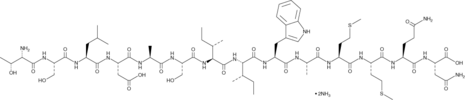
Disitertide is a peptide inhibitor of TGF-β1-mediated activity that corresponds to amino acids 730-743 of the membrane proximal ligand-binding domain of human TGF-β receptor type 3 (TGFBR3), also known as beta-glycan.1,2 It inhibits the binding of TGF-β1 to TGF-β1 receptors in Mv 1 Lu mink lung epithelial cells by 95% at 200 µg/ml and rescues TGF-β1-inhibited growth in the same cells.1 Disitertide reduces TGF-β1-mediated reporter expression in primary human fetal skin fibroblasts at 50 and 100 µg/ml and decreases hepatic stellate cell (HSC) activation and liver fibrosis in a rat model of chronic liver injury. Topical application of disitertide reduces connective tissue growth factor (CTGF) levels and the number of myofibroblasts expressing α-smooth muscle actin (α-SMA) in the skin secretions of mice in a model of scleroderma and decreases dermal fibrosis in the same model.2
WARNING This product is not for human or veterinary use.
References & Product Citations
1. A synthetic peptide from transforming growth factor β type III receptor inhibits liver fibrogenesis in rats with carbon tetrachloride liver injury. Cytokine 22(1-2), 12-20 (2003).
2. Topical application of a peptide inhibitor of transforming growth factor-
Contact Info
Cayman Chemical1180 East Ellsworth RoadAnn Arbor, Michigan 48108 USAToll Free: (800) 364-9897(USA and Canada only)Fax: (734) 971-3640


