
Technical Support & Resources
Information provided in the product description is from published literature. Due to the nature of scientific experimentation, your results (e.g., selectivity and effective concentrations) or specific application for this product may differ. If you have questions about how this product fits your application, please contact our technical support staff.
Visit our FAQ
Contact Us
Toll Free Phone (USA and Canada Only): (888) 526-5351
Direct Phone: (734) 975-3888
Technical Information
- (±)-Halofantrine
- SKF 102886
- WR 171669
Shipping & Storage Information
Recommended Products
Certificates of Analysis & Batch Specific Data
Provide batch numbers separated by commas to download or request available product inserts, QC sheets, certificates of analysis, data packs, and GC-MS data.
Neutrophil Biology Wall Poster
Explore how neutrophils shape the immune response in health and disease. This poster highlights neutrophil pathogen defense mechanisms, including phagocytosis, degranulation, and NETosis, as well as neutrophil roles in inflammation and NET-associated pathologies.
DOWNLOAD NOWProduct Description
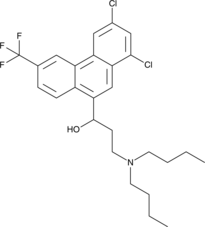
Halofantrine is an antimalarial agent.1 It is active against P. yoelii (IC50 = 2.32 µM) and drug-sensitive and -resistant strains of P. falciparum (IC50s = 0.2-1.1 nM). Halofantrine (4 mg/kg) reduces parasitemia in a mouse model of P. yoelii infection.2 It also inhibits human-ether-a-go-go (hERG), also known as Kv11.1, in HEK293 cells expressing the human channel (IC50 = 0.04 µM) and induces bradycardia and QT prolongation in anesthetized guinea pigs at 10 mg/kg.3,4 Formulations containing halofantrine have previously been used in the treatment of malaria.
WARNING This product is not for human or veterinary use.
References & Product Citations
1. The activities of current antimalarial drugs on the life cycle stages of Plasmodium: A comparative study with human and rodent parasites. PLoS Med. 9(2), e1001169 (2012).
2. Modulation of halofantrine resistance after coadministration of halofantrine with diverse pharmacological agents in a rodent malaria model. Life Sci. 67(11), 1345-1354 (2000).
3. Inhibition of hERG K+ currents by antimalarial drugs in stably transfected HEK293 cells. Eur. J. Pharmacol. 484(1), 41-48 (2004).
4. Comparison of the acute cardiotoxicity of the antimalarial drug halofantrine in vitro and in vivo in anaesthetized guinea-
Contact Info
Cayman Chemical1180 East Ellsworth RoadAnn Arbor, Michigan 48108 USAToll Free: (800) 364-9897(USA and Canada only)Fax: (734) 971-3640


