
Technical Support & Resources
Information provided in the product description is from published literature. Due to the nature of scientific experimentation, your results (e.g., selectivity and effective concentrations) or specific application for this product may differ. If you have questions about how this product fits your application, please contact our technical support staff.
Visit our FAQ
Contact Us
Toll Free Phone (USA and Canada Only): (888) 526-5351
Direct Phone: (734) 975-3888
Product Categories
Product Type
Technical Information
- Isobutyrylthiamine Disulfide
Shipping & Storage Information
Recommended Products
Certificates of Analysis & Batch Specific Data
Provide batch numbers separated by commas to download or request available product inserts, QC sheets, certificates of analysis, data packs, and GC-MS data.
Product Description
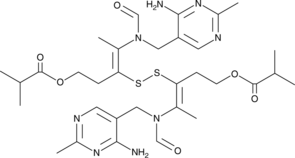
Sulbutiamine is a lipid-soluble, brain-penetrant derivative of thiamine (Item Nos. 25656 | 25332), also known as vitamin B1, that is composed of two thiamine molecules linked by a disulfide bond and each containing an isobutyryl group.1,2 It crosses cellular membranes and is converted to thiamine intracellularly.2 Sulbutiamine increases thiamine levels in the serum, kidney, medulla, cerebellum, and cerebral cortex when administered at a dose of 52 mg/kg.3 It increases the viability of neurons in rat hippocampal slices in an in vitro model of ischemia using oxygen-glucose deprivation (OGD).1 Sulbutiamine (500 mg/kg) reduces neuroinflammation and oxidative stress in a rat model of cerebral ischemia.4 It also reduces anxiety- and depressive-like behaviors and improves recognition memory in the same model. Sulbutiamine (25 mg/kg) improves object recognition memory in experimentally naïve rats.5
WARNING This product is not for human or veterinary use.
References & Product Citations
1. Evidence for neuroprotective effect of sulbutiamine against oxygen-
2. Thiamine and benfotiamine protect neuroblastoma cells against paraquat and β-
3. Injection of sulbutiamine induces an increase in thiamine triphosphate in rat tissues. Biochem. Pharmacol. 40(11), 2557-2560 (1990).
4. Sulbutiamine ameliorates cognitive impairment, neuroinflammation, and oxidative stress in rats with cerebral ischemia. Bratisl. Med. J. 127, 1530-1542 (2026).
5. Chronic treatment with sulbutiamine improves memory in an object recognition task and reduces some amnesic effects of dizocilpine in a spatial delayed-
Contact Info
Cayman Chemical1180 East Ellsworth RoadAnn Arbor, Michigan 48108 USAToll Free: (800) 364-9897(USA and Canada only)Fax: (734) 971-3640


