
Technical Support & Resources
Visit our FAQ
Contact Us
Toll Free Phone (USA and Canada Only): (888) 526-5351
Direct Phone: (734) 975-3888
Product Categories
Application
Technical Information
- NARC-1
- Proprotein Convertase Subtilisin Kexin 9
Shipping & Storage Information
Recommended Products
Certificates of Analysis & Batch Specific Data
Provide batch numbers separated by commas to download or request available product inserts, QC sheets, certificates of analysis, data packs, and GC-MS data.

Explore Obesity & Metabolic Disease Resources
Discover high-quality research tools to investigate GLP-1 mechanisms and next-generation metabolic targets.
OBESITY RESEARCH SOLUTIONSProduct Description
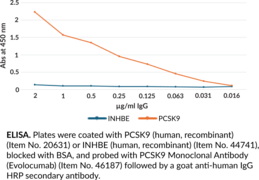
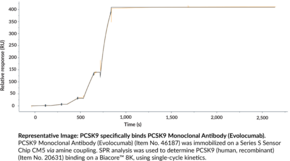
Proprotein convertase subtilisin kexin 9 (PCSK9) is a zymogen and member of the subtilisin serine protease family that reduces protein levels of LDL receptors (LDLRs), the receptor for LDL-cholesterol (LDL-C).1,2 It is primarily expressed in the liver and is composed of an N-terminal prodomain that regulates PCSK9 maturation, a catalytic domain containing a catalytic aspartic acid-histidine-serine triad, and a C-terminal domain that contains the LDLR binding site.2,3,4 PCSK9 is synthesized as a proprotein that is autocatalytically cleaved to generate the 63 kDa mature protein in which the N-terminal prodomain remains non-covalently bound to the catalytic domain to inhibit further activity.4 The mature PCSK9 is secreted and circulates in the plasma, where it binds to cell surface-expressed LDLRs, triggering endocytosis and lysosomal degradation of the PCSK9-LDLR complex.2 This action decreases LDLR expression and reduces cellular LDL-C uptake. Gain-of-function and loss-of-function PCSK9 mutations have been associated with autosomal dominant hypercholesterolemia and decreased plasma LDL-C levels, respectively, in humans.2 Formulations containing monoclonal antibodies targeting PCSK9 have been used in the treatment of hyperlipidemia, familial hypercholesterolemia, and cardiovascular disease. Cayman's PCSK9 Monoclonal Antibody (Evolocumab) was produced recombinantly from the original PCSK9 antibody sequence and can be used for ELISA and surface plasmon resonance (SPR) applications.
WARNING This product is not for human or veterinary use.
References & Product Citations
1. Overexpression of PCSK9 accelerates the degradation of the LDLR in a post-
2. Molecular and cellular function of the proprotein convertase subtilisin/kexin type 9 (PCSK9). Basic Res. Cardiol. 110(2), 4 (2015).
3. The secretory proprotein convertase neural apoptosis-
4. PCSK9: Regulation and target for drug development for dyslipidemia. Annu. Rev. Pharmacol. Toxicol. 57, 223-244 (2017).
Contact Info
Cayman Chemical1180 East Ellsworth RoadAnn Arbor, Michigan 48108 USAToll Free: (800) 364-9897(USA and Canada only)Fax: (734) 971-3640


