
Technical Support & Resources
Information provided in the product description is from published literature. Due to the nature of scientific experimentation, your results (e.g., selectivity and effective concentrations) or specific application for this product may differ. If you have questions about how this product fits your application, please contact our technical support staff.
Visit our FAQ
Contact Us
Toll Free Phone (USA and Canada Only): (888) 526-5351
Direct Phone: (734) 975-3888
Technical Information
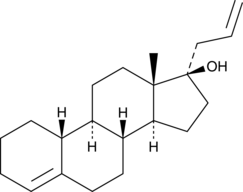
- 17α-Allyl-17β-hydroxy-4-estren
- NSC 37723
Shipping & Storage Information
Recommended Products
Certificates of Analysis & Batch Specific Data
Provide batch numbers separated by commas to download or request available product inserts, QC sheets, certificates of analysis, data packs, and GC-MS data.
Product Description
Allylestrenol is a prodrug form of the progesterone receptor agonist 3-keto allylestrenol.1,2 Unlike 3-keto allylestrenol, allylestrenol is a weak agonist of androgen and progesterone receptors in reporter assays (EC50s = 663 and 381 nM, respectively), and it does not bind to estrogen or glucocorticoid receptors. Allylestrenol protects against embryo resorptions and decreases in serum progesterone levels, fetal weight, and placental weight induced by misoprostol (Item No. 13820) in mice.3 It decreases ventral prostate and seminal vesicle weight in mature male rats and inhibits testosterone propionate-induced ventral prostate and seminal vesicle growth in castrated immature rats.4 Neonatal administration of allylestrenol (17.5 µg/animal) decreases bone mineral content in female rats and increases it in male rats but does not affect bone mineral density in either female or male rats.5
WARNING This product is not for human or veterinary use.
References & Product Citations
1. Structure-
2. Receptor binding of allylestrenol, a progestagen of the 19-
3. Allylestrenol prevents misoprostol-
4. Effects of steroid 5α-
5. Effect of perinatal synthetic steroid hormone (allylestrenol, diethylstilbestrol) treatment (hormonal imprinting) on the bone mineralization of the adult male and female rat. Life Sci. 64(9), PL105-PL110 (1999).
Contact Info
Cayman Chemical1180 East Ellsworth RoadAnn Arbor, Michigan 48108 USAToll Free: (800) 364-9897(USA and Canada only)Fax: (734) 971-3640


