
Technical Support & Resources
Information provided in the product description is from published literature. Due to the nature of scientific experimentation, your results (e.g., selectivity and effective concentrations) or specific application for this product may differ. If you have questions about how this product fits your application, please contact our technical support staff.
Visit our FAQ
Contact Us
Toll Free Phone (USA and Canada Only): (888) 526-5351
Direct Phone: (734) 975-3888
Product Categories
Technical Information
- AniHBr
Shipping & Storage Information
Recommended Products
Certificates of Analysis & Batch Specific Data
Provide batch numbers separated by commas to download or request available product inserts, QC sheets, certificates of analysis, data packs, and GC-MS data.
Neutrophil Biology Wall Poster
Explore how neutrophils shape the immune response in health and disease. This poster highlights neutrophil pathogen defense mechanisms, including phagocytosis, degranulation, and NETosis, as well as neutrophil roles in inflammation and NET-associated pathologies.
DOWNLOAD NOWProduct Description
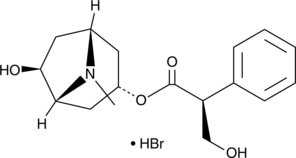
Anisodamine is a polyketide synthase-derived tropane alkaloid that has been found in S. tangutica and has diverse biological activities.1,2,3,4,5 It induces relaxation in isolated rat and rabbit intestinal smooth muscles precontracted with acetylcholine (ACh; Item No. 23829).2 Anisodamine (3.6 mg/kg, i.v.) reduces serum and renal TNF-α, IL-1β, malondialdehyde (MDA), and superoxide dismutase (SOD) levels and rescues decreases in mean arterial pressure (MAT) in a rat model of sepsis induced by LPS.3 It decreases myocardial tissue damage and increases sublingual and intestinal microcirculatory blood flow in a pig model of ischemia-reperfusion injury.4 Anisodamine inhibits the replication of severe acute respiratory syndrome coronavirus 2 (SARS-CoV-2) in Vero E6 cells.5
WARNING This product is not for human or veterinary use.
References & Product Citations
1. Engineering the production of medicinal tropane alkaloids through enhancement of tropinone and littorine biosynthesis in root cultures of Atropa belladonna. Ind. Crops Prod. 189, 115778 (2022).
2. The inhibitory effect of anisodamine hydrobromide against contraction of intestinal smooth muscles induced by acetylcholine, with its pharmacokinetics and mechanism investigation. Nat. Prod. Commun. 21(5), 1-14 (2026).
3. Protective effect of anisodamine hydrobromide on lipopolysaccharide-
4. Anisodamine hydrobromide ameliorates cardiac damage after resuscitation. Exp. Ther. Med. 23(6), 422 (2022).
5. Anisodamine potently inhibits SARS-
Contact Info
Cayman Chemical1180 East Ellsworth RoadAnn Arbor, Michigan 48108 USAToll Free: (800) 364-9897(USA and Canada only)Fax: (734) 971-3640


