
Technical Support & Resources
Information provided in the product description is from published literature. Due to the nature of scientific experimentation, your results (e.g., selectivity and effective concentrations) or specific application for this product may differ. If you have questions about how this product fits your application, please contact our technical support staff.
Visit our FAQ
Contact Us
Toll Free Phone (USA and Canada Only): (888) 526-5351
Direct Phone: (734) 975-3888
Product Categories
Technical Information
- EHT
- Octyl Triazone
Shipping & Storage Information
Recommended Products
Certificates of Analysis & Batch Specific Data
Provide batch numbers separated by commas to download or request available product inserts, QC sheets, certificates of analysis, data packs, and GC-MS data.

Visit Our Environmental Toxicology Resource Center
Explore additional resources to study natural toxins, pollutants including PFAS and 6-PPD-Q, and their biological effects.
ENVIRONMENTAL TOXICOLOGY TOOLS & SERVICESProduct Description
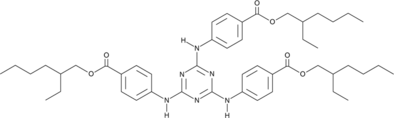
Ethylhexyl triazone (EHT) is a triazine UVB filter.1 It does not induce mortality in A. salina brine shrimp and does not affect the growth of Tetraselmis marine microalga at 2 mg/L.2 However, EHT is acutely lethal to the rotifer B. calyciflorus (LC50 = 12.86 mg/L).3 EHT is not genotoxic to Chinese hamster lung (CHL) cells in vitro and does not induce phototoxicity in guinea pigs.1 It has been found in wastewater.4 Formulations containing EHT have been used as sun protectants in sunscreen products.
WARNING This product is not for human or veterinary use.
References & Product Citations
1. Assessment of the potential genotoxicity and phototoxicity of triazine UV filters. J. Dermatol. Sci. Cosmet. Technol. 2(2), 100087 (2025).
2. Effect of 10 UV filters on the brine shrimp Artemia salina and the marine microalga Tetraselmis sp. Toxics 8(2), 29 (2020).
3. Ethylhexyl triazone sunscreen and its disinfection byproducts obtained after chlorine treatment: Ecofriendliness or ecotoxicity? Sci. Total Environ. 955:177279, (2024).
4. Fate and removal of polycyclic musks, UV filters and biocides during wastewater treatment. Water Res. 40(14), 2603-2612 (2006).
Contact Info
Cayman Chemical1180 East Ellsworth RoadAnn Arbor, Michigan 48108 USAToll Free: (800) 364-9897(USA and Canada only)Fax: (734) 971-3640


